Berat and Gjirokastër
Two UNESCO cities in southern Albanie, one white at the foot of Tomorr, the other in grey stone on Mali i Gjerë, completed by Apollonia and the Osum canyon.
Southern Albanie concentrates within 150 kilometres two of the finest museum-cities of the Balkans, Berat and Gjirokastër, both inscribed on the UNESCO World Heritage list. Our team regularly organizes this circuit from Tirana, and we consider it the best entry point for understanding the Ottoman, Byzantine and Illyrian layers that compose the country's identity. The two cities are nothing alike: Berat is white, set on the banks of the Osum, dominated by Mount Tomorr (2,416 m) considered sacred by Bektashis. Gjirokastër is grey, tiered on the flank of Mali i Gjerë, built of limestone and slate that turns blue in the rain.
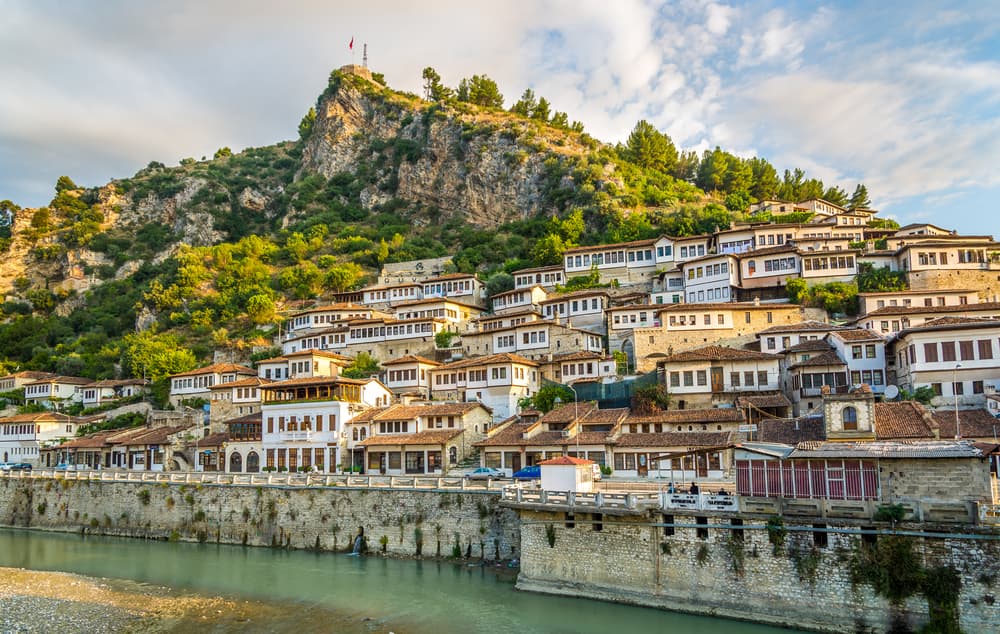
Berat is nicknamed the city of a thousand windows, referring to the timber-framed façades of the Mangalem quarter that pile up on the right bank of the Osum. Facing it, the Christian quarter of Gorica tiers its houses on the other side of the 18th-century Ottoman bridge. The Kalaja citadel, still inhabited, houses a dozen Byzantine churches and the Onufri museum, named after the Albanian master iconographer of the 16th century. Further down, the Mangalem quarter preserves the King's Mosque (15th century) and the Halveti tekke, testimony to a long coexistence between Sufi Islam and Orthodoxy.
Gjirokastër, 130 kilometres to the south, functions differently. The fortress dominates the city at 336 metres of altitude and preserves a collection of Ottoman artillery and an American spy plane captured in 1957. The bazaar, restored, leads to the 18th-century tower houses, notably the Zekate on five levels, which gives a precise idea of the habitat of a bey family. The birthplace of Ismail Kadaré, whose novel Chronicle of the Stone City unfolds here, and that of Enver Hoxha, the communist dictator born a few streets away, tell the rougher story of 20th-century Albanie.
Between the two, two stops complete the journey. The archaeological site of Apollonia, founded by Corinthian colonists around 588 BCE, preserves a bouleuterion, an odeon and the 13th-century Orthodox monastery of Saint Mary, set on cereal hills above the Myzeqe plain. The blue springs of Syri i Kaltër (the Blue Eye), a karstic resurgence some 50 metres deep, feed the Bistricë river 18 kilometres from Sarandë, at a constant temperature of 10°C. For adventure-minded travellers, the Osum canyon, between Çorovodë and Skrapar, can be descended by rafting or canyoning from April to June when water levels permit, over 13 kilometres of deep gorges.
Southern cuisine reflects robust Mediterranean agriculture: olive oil from the Berat region, wines from Çobo and Kantina Nurellari (shesh i bardhë grape variety), lamb baked in the oven served with qifqi (rice balls with mint, a Gjirokastër speciality), tarator with yoghurt and cucumber. Mulberry or grape raki accompanies meals. Saturday markets in Berat and Gjirokastër remain frequented by producers from surrounding villages, notably from Lazarat and Libohovë.
Rural life continues just 20 minutes from the city centres. The villages of Roshnik, south of Berat, and Lekël or Antigonea, around Gjirokastër, live from olives, sheep's cheese and still-discreet rural tourism that we encourage through our partners in family guesthouses.
Must-see
Inhabited citadel of Berat. Kalaja is explored on foot among still-occupied Ottoman houses, a dozen Byzantine churches and the Onufri museum which preserves the icons of the 16th-century master. Sweeping views over the Osum and Tomorr at day's end.
Tower houses of Gjirokastër. The Zekate and Skenduli house, on five levels, illustrate the fortified habitat of 18th-century Ottoman families, with their painted ceilings, private hammams and oak timber framing.
Descent of the Osum canyon. 13 kilometres of limestone gorges 70 metres high between Çorovodë and Goran bridge, by raft or canyoning. Possible April to mid-June, when snowmelt from Tomorr feeds the flow.
Apollonia of Illyria. Greek city founded in 588 BCE by Corinth, preserving a bouleuterion, odeon and nymphaeum on grassy hills. The Orthodox monastery of Saint Mary, at the centre of the site, houses a lapidary museum.
Syri i Kaltër. Karstic resurgence approximately 50 metres deep, water at 10°C year-round, whose dark blue hue owes to the geology of Mali i Gjerë. Access via a 2-kilometre track from the Sarandë-Gjirokastër road.
When to visit
The climate is Mediterranean with continental influence at altitude. The best windows are May-June and September-mid-October: temperatures of 22 to 28°C by day, cool evenings at Gjirokastër perched at 300 metres, vegetation still green in spring, grape harvests and golden light in autumn. April also works, with abundant water in the canyons but cold nights around 8°C.
July and August reach 35°C on the plain (Berat, Apollonia) and remain tolerable at 28-30°C in Gjirokastër thanks to altitude. Italian and Albanian visitor numbers weigh on accommodation, which we recommend booking three months in advance. From mid-November to March, rainfall is marked on the southern slope (150 to 200 mm monthly in December), some secondary roads become difficult, and the Osum canyon is closed. The cities remain visitable with particular charm under snow, which falls once or twice per winter in Gjirokastër.
Practical advice
We recommend a minimum of 4 days for this region, 5 if including Apollonia and Syri i Kaltër. The natural entry point is Tirana airport, 2.5 hours' drive from Berat via the SH4 motorway, then 2 additional hours to Gjirokastër via the SH4 and SH75. The international airport in Vlora, currently nearing completion, will alter these logistics shortly. We work with private car and English-speaking driver; self-drive rental is possible but not particularly comfortable on secondary roads.
The itinerary logically combines with the Ionian Riviera to the south (Gjirokastër is 1.5 hours from Sarandë via the Muzina pass) for an 8 to 10-day culture-and-beach mix, or with Tirana and the centre at the beginning or end of the circuit. For travellers with 15 days, the sequence Tirana, Berat, Gjirokastër, Riviera, then back up through the Albanian Alps constitutes our most comprehensive proposal. Comfort ranges from restored family guesthouses (our preference in Berat and Gjirokastër, in historic quarters) to 4-star hotels. The region suits contemplatives, architecture and history enthusiasts, families with children from 8 years old, and moderate walkers. Active travellers will find Osum canyoning and trails in Tomorr National Park.