Eastern Lakes
Three border lakes between Montenegro, North Macedonia and Greece, colonies of Dalmatian pelicans at Prespa and the cultural city of Korçë as a grand finale.
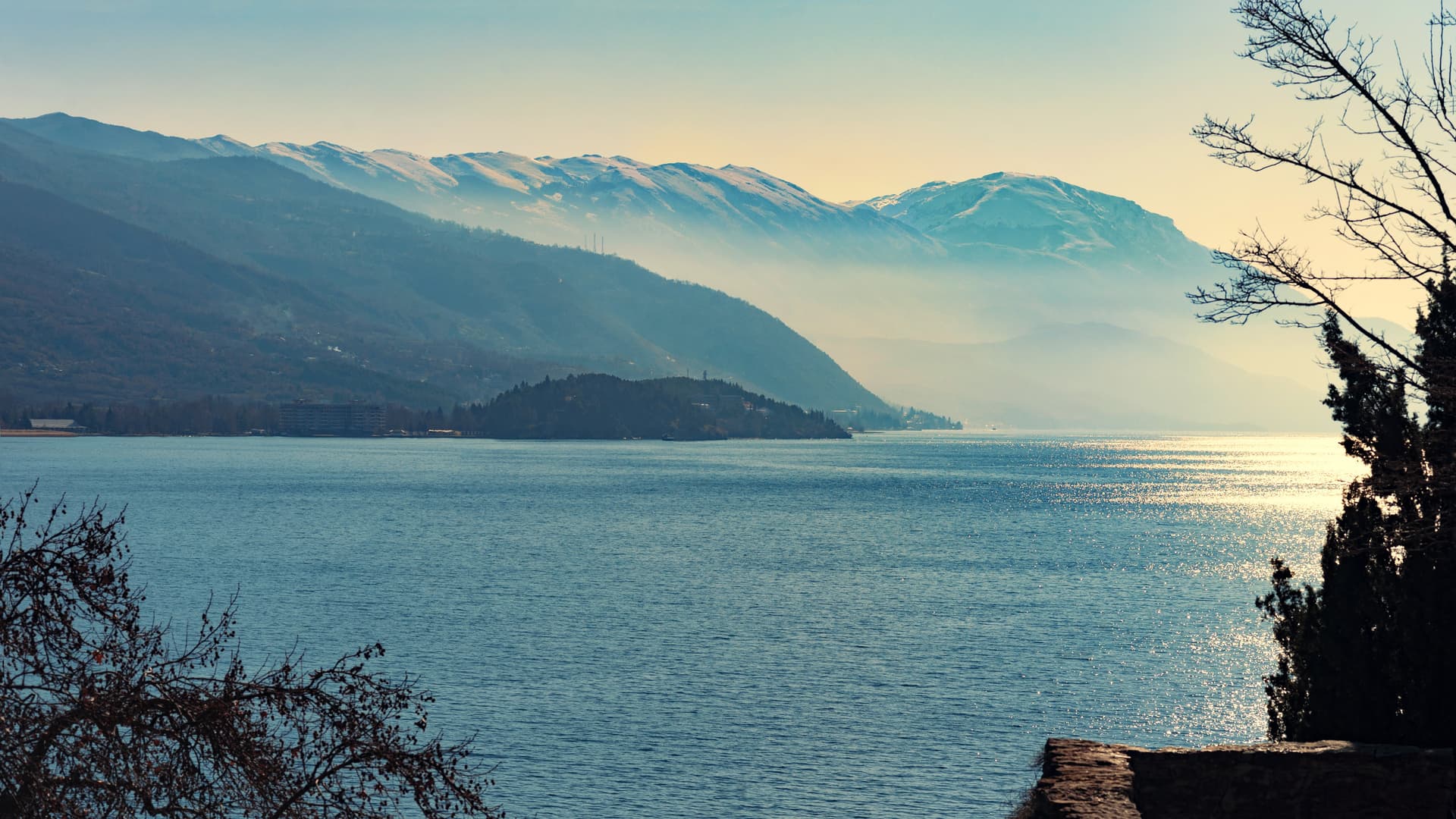
Eastern Albania is organized around three lake basins that mark the borders with Montenegro, North Macedonia and Greece. Lake Skadar in the north, shared with Montenegro, covers 370 km² depending on the season and constitutes the largest freshwater expanse in the Balkans. Further to the southeast, Lake Ohrid stretches at 695 metres altitude between Pogradec and the Macedonian shore, with depths reaching 288 metres. Finally, the two lakes of Prespa, the Greater and Lesser, are shared between Albania, North Macedonia and Greece at 850 metres altitude, nestled in a mountain cirque that few travellers cross.
These three basins do not form a homogeneous region. Between Shkodër, the gateway city to Lake Skadar on the edge of the northern plain, and Korçë, the cultural capital perched at 850 metres on the southeastern plateau, lies nearly 250 kilometres of road and a complete change in climate, cuisine and architecture. This diversity is what we propose to explore as a thread, not as a compressed circuit.
Lake Ohrid concentrates the scientific dimension of the region. Its waters harbour over 200 endemic species, including the Koran trout that fishermen from Lin and Tushemisht bring up by boat. On the eastern shore, just across the border, the monastery of Sveti Naum, founded in the 9th century, can be visited in half a day from Pogradec. On the Albanian side, the village of Lin juts out on a basalt peninsula and preserves the paleochristian mosaics of a 6th-century basilica. In Pogradec, the cuisine revolves around grilled fish, pork trotters in aspic and tavë kosi from the nearby highlands.
Further south, the lakes of Prespa remain one of the least frequented areas of the country. The Prespa National Park, established in 1999, shelters the largest colony of Dalmatian pelicans in the Balkans, roughly 1,400 couples, observable from April to June from the island of Maligrad and its 14th-century rock church. The village of Pustec, inhabited by a Macedonian minority, provides access to mixed forest trails where brown bears and lynx still survive. Population density remains below 10 inhabitants per km², which radically changes the experience compared to Ohrid.
In the north, Lake Skadar is experienced differently. From the village of Shiroka, 7 kilometres from Shkodër, flat-bottomed boats cross through reed beds to the monastic island of Beška or the ruins of Grmožur fortress. The region produces a red wine from Kallmet grapes and smoked carp found on family tables. Shkodër itself, once a Catholic cultural capital, retains the citadel of Rozafa which dominates the confluence of the Drin, Buna and Kir rivers.
Korçë, at the end of the chain to the southeast, closes this loop of lakes without being directly part of it. The city bears the heritage of Aromanians and Sephardic Jews who made it a thriving commercial hub between Salonika and Vienna in the 19th century. Its beer brewed since 1928, its polyphonic serenades inscribed on UNESCO's list and its restored old bazaar justify two nights here before descending towards Berat or heading to the Riviera.
Must-see
Dalmatian pelicans of Prespa Park. Boat excursion departing from Pustec from April to June to observe nesting colonies around the island of Maligrad and its rock church carved into the cliff face.
Lin and the mosaics of Lake Ohrid. Walk to the top of the Lin peninsula to see 6th-century paleochristian mosaics, then lunch on grilled Koran trout at a local home facing the Macedonian shore.
Crossing Lake Skadar from Shiroka. Early morning departure from Shiroka to reach the reed beds, the island fortress of Grmožur and observe purple herons and pygmy cormorants nesting in the willows.
Old bazaar and brewery in Korçë. Evening in the restored bazaar, dinner accompanied by polyphonic serenades and a visit to the historic brewery founded in 1928, the country's first.
Monastery of Sveti Naum from Pogradec. Border crossing at Tushemisht and 6 kilometres to the 9th-century monastery, set above the sub-lake springs that feed the southern end of Lake Ohrid.
When to visit
The best window spans May through early July, then September and October. In spring, the Prespa lakes reach 18 to 22°C during the day at 850 metres, making pelican-watching outings comfortable, and meadow flowering around Pustec lasts until mid-June. In September, Lake Ohrid water remains at 22°C and permits swimming in Pogradec, with air temperatures around 25°C and more stable skies than in May.
July and August are hot in Shkodër, often 33 to 36°C, and mosquito nets become essential in the Skadar reed beds. We avoid December to February for Prespa and Korçë: snow falls regularly above 800 metres, some secondary roads become difficult and most family-run accommodation structures around the lakes close. November and March remain practicable but rainy, with 100 to 130 mm cumulated over the Skadar basin, among the wettest areas of the country.
Practical advice
Allow 5 to 7 days to properly traverse all three lake systems, keeping in mind that road distances are lengthened by terrain: 4 hours between Shkodër and Pogradec via Tirana, 2 additional hours to reach Prespa then Korçë. A more focused visit to Ohrid and Korçë fits in 3 days from Tirana, whose airport remains the logical entry point. In the north, Shkodër naturally pairs with the Albanian Alps for those wanting to combine lakes and mountains, while Korçë to the south easily pairs with Berat and Gjirokastër before heading to the Ionian Riviera.
Accommodation relies mainly on family guesthouses and a few mid-range hotels in Pogradec, Korçë and Shkodër. Comfort is adequate without being luxurious, and local cuisine—lake fish, plateau vegetables, sheep cheeses—often justifies stops as much as landscapes. The region suits contemplative travellers, ornithology enthusiasts and families with walking-age children, less so serious hikers seeking sustained elevation gain, who should head instead to the northern Alps.