Pristina
Pristina
Pristina, capital of Kosovo, is a city in full transformation where 15th-century mosques, a library with 99 domes, and a vibrant urban scene coexist, powered by one of Europe's youngest populations.
Pristina is the capital of Kosovo, a young city undergoing profound transformation. Once an Ottoman settlement that became a Balkan metropolis, it brings together 15th-century mosques, Yugoslav brutalist architecture, and trendy cafés frequented by one of Europe's youngest populations. Its compact center can be explored on foot in a day, yet the city rewards a longer stay.
Practical Information at a Glance
- Access: Adem Jashari International Airport approximately 18 km from the center; shuttles and taxis available.
- Currency: Euro (EUR), although Kosovo is not a member of the eurozone.
- Language: Albanian (official); English is widely understood in the city center.
- Recommended Duration: 1 to 2 days for the main sites.
- Dress Code: Appropriate attire required in mosques; shoulders and knees should be covered.
What to See
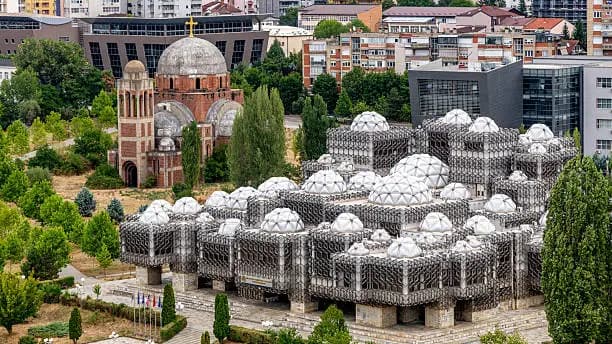
Pristina's center revolves around Mother Teresa Boulevard, a pedestrian thoroughfare lined with terraces. The Clock Mosque (Xhamia e Çarshisë) and the Fatih Mosque, dating from the 15th century, bear witness to Ottoman heritage. The National Museum of Kosovo traces the country's history from prehistory through independence in 2008. The national library, with its 99 domes and metallic cladding, stands as one of the most distinctive buildings in the Balkans.
History and Context
Pristina has been inhabited since antiquity; Illyrian and Roman remains have been discovered in the region. Under the Ottoman Empire (15th–19th centuries), it became an important commercial and religious center. After decades under Yugoslavia, Kosovo declared independence in February 2008—one of the world's most recent. This recent and painful history deeply shapes the city's identity.
Highlights of Your Visit
The National Library
Designed by Croatian architect Andrija Mutnjaković and inaugurated in 1982, the national library is an extraordinary architectural statement. Its 99 domes of varying sizes and gridded metal facade make it an ambiguous symbol, both criticized and celebrated. Inside, significant collections document Albanian and Kosovar history.
The Fatih Mosque
Built in the 15th century under Mehmed II's reign, it ranks among the city's oldest monuments. Its austere architecture, typical of classical Ottoman design, contrasts with the bustle of the adjacent bazaar. It remains an active place of worship.
The National Museum of Kosovo
Housed in an Austro-Hungarian era building, the museum displays archaeological, ethnographic, and historical collections. The section dedicated to the 1998–1999 war and independence is particularly well-documented.
The "Newborn" Statue
Installed on the day of independence declaration, February 17, 2008, this oversized letter sculpture is repainted each year to mark the anniversary. It has become Pristina's most recognizable visual symbol.
Etiquette and Visiting Rules
- Remove your shoes before entering mosques.
- Cover shoulders and knees; covering garments are sometimes provided at the entrance.
- Avoid visits during Friday prayer times.
- Ask permission before photographing worshippers.
Photography Tips
The national library is most photogenic in morning light, before crowds arrive. The "Newborn" statue photographs well in late afternoon, facing the sunset. The bazaar (Çarshia) offers lively street scenes mid-morning. Rooftops in the center afford clear views of minarets and surrounding hills.
Location and Access
Pristina lies in central Kosovo, in a plain surrounded by hills. The historic center is compact and entirely walkable. Buses regularly connect Pristina to Prizren, Peja (Peć), and other nearby major cities. Accessibility for persons with reduced mobility in the city center remains limited due to uneven sidewalks.
Nearby Attractions
- Prizren — Former Ottoman capital of Kosovo, featuring a citadel, mosques, and an ancient stone bridge over the Bistrica River.
- Peja (Peć) — City in western Kosovo, gateway to the Rugova Gorges and seat of the Serbian Orthodox Patriarchate.
- Gračanica Monastery — Masterpiece of medieval Byzantine architecture, UNESCO World Heritage site, a few kilometers southeast of Pristina.
- Rugova Gorges — Spectacular canyon ideal for hiking and climbing, accessible from Peja.
Want to discover this destination?
Our local advisors design your tailor-made trip.