Prizren Fortress (Kalaja e Prizrenit)
Prizren Fortress (Kalaja e Prizrenit)
Overlooking the old town of Prizren, the medieval fortress offers panoramic views of tiled roofs and minarets, with Byzantine, Serbian, and Ottoman ruins to explore on foot.
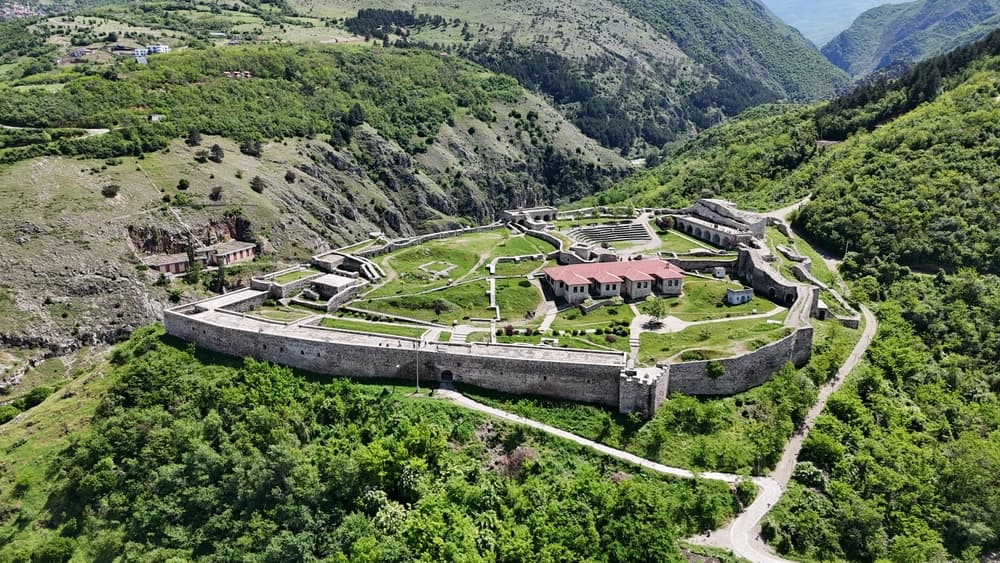
Perched on a rocky outcrop dominating the old town of Prizren, the medieval Prizren Fortress commands stunning panoramic views of red-tiled roofs, minarets, and surrounding hills. A remnant of the Byzantine, medieval Serbian, and Ottoman empires, it embodies centuries of Balkan history. It is one of Kosovo's most visited sites, accessible on foot from the historic center in about twenty minutes.
Practical Information at a Glance
- Access: Climbing on foot from Prizren's bazaar, a marked path alongside the Bistrica River then through the narrow streets of the old town
- Recommended duration: 1 to 1.5 hours (visit + panorama)
- Attire: Walking shoes recommended; the ground is uneven
- Accessibility for people with reduced mobility: Not accessible — steep climb and uneven cobblestones
What You'll See
The ramparts preserve several towers and stretches of stone walls, some dating back to the Byzantine era. Within the fortress walls, the ruins of a medieval church dedicated to Saint George remain visible. The summit terrace offers a 360° view of Prizren, the White Drin valley, and the Šar Planina mountains.
History and Context
The earliest fortifications date to late antiquity. The fortress was enlarged under the Byzantine Empire, then became a stronghold of the medieval Serbian kingdom in the 13th-14th centuries, under the Nemanjić dynasty. The Ottomans captured it in the 15th century and reinforced it. It played a strategic role until the 19th century. Partial consolidation work has been undertaken in recent decades.
Highlights of the Visit
The Panorama of Prizren
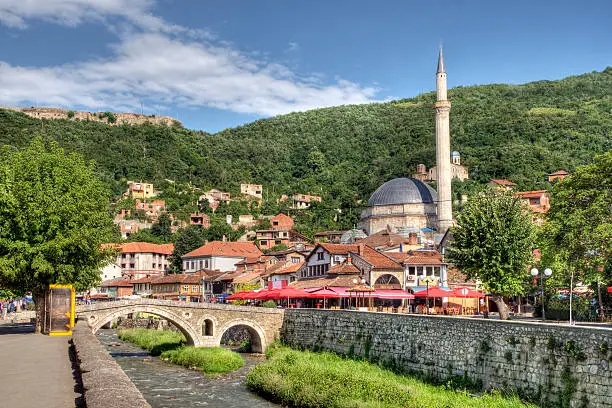
From the rampart walk, the view encompasses the entire old town: the Sinan Pasha Mosque, the Ottoman bridge over the Bistrica, and the wooded hills. It is one of Kosovo's most comprehensive urban panoramas.
The Ruins of the Church of Saint George
Within the fortress walls, the vestiges of this medieval church testify to the Serbian period. The walls retain traces of fine masonry, characteristic of Nemanjić architecture.
The Ramparts and Towers
Walking along the ramparts allows you to observe different construction phases: Byzantine stonework, medieval Serbian additions, and Ottoman reinforcements are visible in the thickness of the walls.
Photography Tips
Morning light is ideal for photographing the city from the ramparts, before heat haze veils the mountains. In late afternoon, the golden light on the tiled roofs is particularly photogenic. No photography restrictions are signaled at the site.
Location and Access
The fortress stands at height, directly above Prizren's historic center. The walking path departs from the bazaar quarter, runs alongside the Bistrica River, and climbs through the old town's narrow streets. Prizren is connected to Pristina by road (approximately 80 km) and regular bus services. No vehicle access to the summit.
Nearby
- Sinan Pasha Mosque — grand 16th-century Ottoman mosque in the heart of the old town, a few minutes' walk away.
- Ottoman Bridge of Prizren — stone bridge over the Bistrica, the natural starting point for the ascent to the fortress.
- Church of Our Lady of Ljeviša — medieval church listed as a UNESCO World Heritage site, in central Prizren.
- Prizren Bazaar — traditional commercial quarter with craftspeople, cafes, and preserved Ottoman architecture.
Frequently asked questions
Spring (April–May) and autumn (September–October) offer pleasant temperatures for the climb. In summer, heat can make the ascent challenging; start early in the morning.
Allow approximately 20 to 30 minutes of walking from the bazaar, depending on your pace. The path is a constant uphill climb on cobbled or dirt terrain.
Walking shoes with non-slip soles are highly recommended. The ground inside the fortress is uneven and can be slippery after rain.
Yes. The fortress naturally pairs with the Sinan Pasha Mosque, the Church of Our Lady of Ljeviša, and the Ottoman bridge, all within a few hundred meters in the old town.
No restrictions are signaled. You are free to photograph the ramparts, ruins, and views of the city.
No. The climb is steep and the interior ground very uneven. The site is not adapted for wheelchairs or strollers.
Interested in this visit?
We can include it in your personalised itinerary.