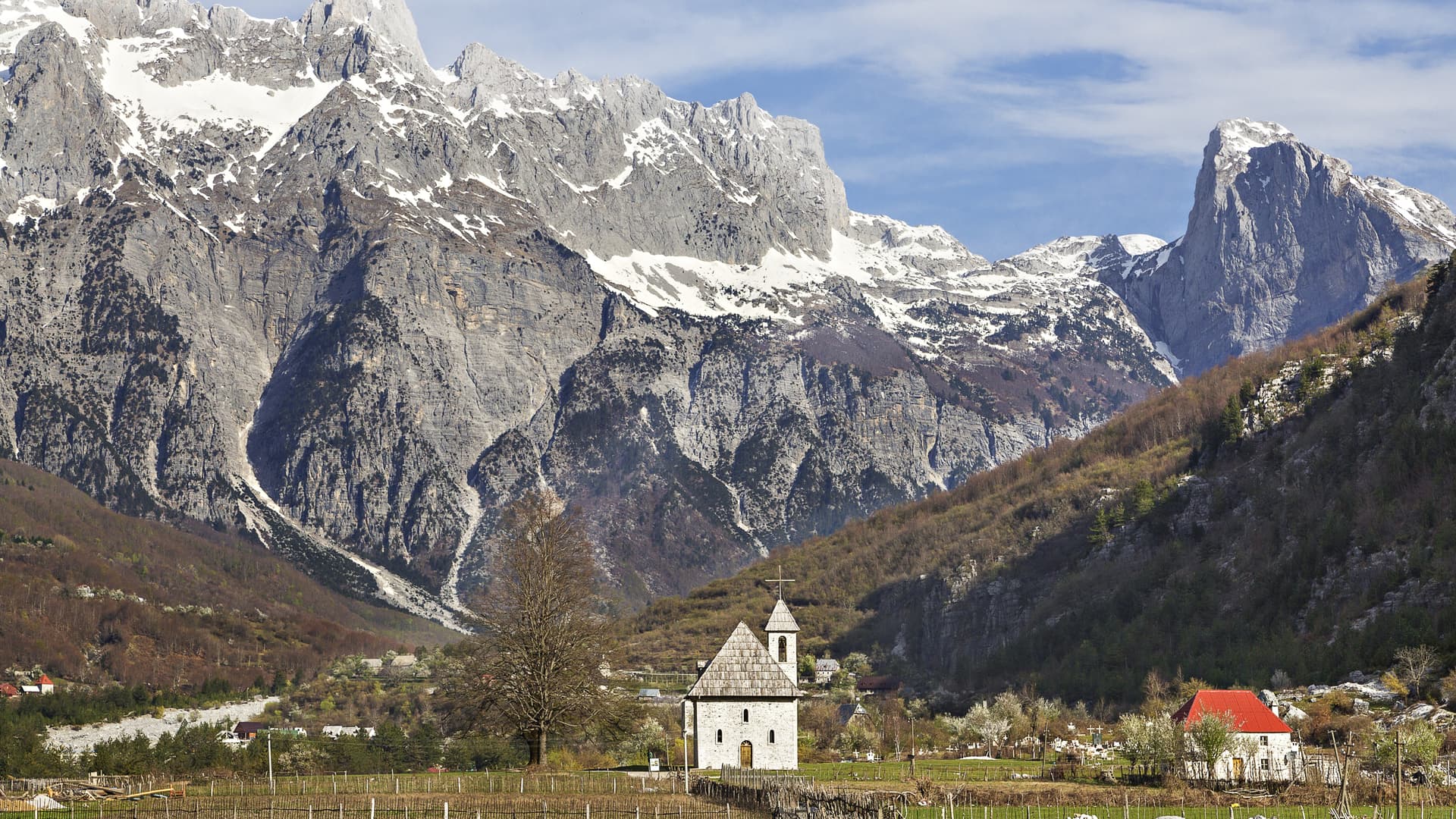
Albanian Alps
Glacial valleys of Theth and Valbona, a 1,759 m pass, the Koman lake ferry and stone towers of the kanun: Albania's only massif where you truly trek at altitude.
The Albanian Alps, called Bjeshkët e Nemuna by locals—the "cursed mountains"—occupy the far north of the country, bordering Kosovo and Montenegro. The massif rises to 2,694 m at Maja Jezercë and is composed of heavily karstified limestone, carved by ancient glaciers into narrow valleys, cirques, and steep passes. It is the only region of Albania where you genuinely climb to altitude over several days of trekking, and where climate conditions impose a strict calendar.
Two valleys concentrate nearly all stays: Theth to the west and Valbona to the east, separated by the Valbona Pass (Qafa e Valbonës) at 1,759 m. Theth is a hamlet scattered around a 19th-century Catholic church, a 25 m waterfall, and the Syri i Kaltër, a glacial blue eye fed by karst springs. Valbona, wider and more open, follows the river of the same name for about twenty kilometres, with hamlets like Rragam and Çerem serving as starting points for summits along the border. The Valbona-Theth crossing, or vice versa, has become the region's classic trek: 6 to 8 hours of walking, roughly 1,100 m of elevation gain, well-marked but rocky trail.
The population is almost exclusively Catholic Gheg, with a social order long governed by the Kanun of Lekë Dukagjini, an oral customary code codified in the 15th century, which notably regulated family vendettas and rules of hospitality. The kullas, stone refuge towers with multiple storeys and gun slits, still testify to this ancient order: several are visited in Theth, including the isolation tower (kulla e ngujimit) where men engaged in blood feuds would retreat. Local economy, long based on transhumant herding and maize cultivation, has largely shifted since 2010 to trekking tourism, with around a hundred family-run guesthouses spread between the two valleys.
The table reflects altitude and remoteness. Fli, a flaky pastry cooked layer by layer under hot ash from a saç for two to three hours, accompanies ewe's yoghurt (kos) and mountain honey. Local drinks include plum rakiá (kumbull) or blueberry rakiá (boronicë), distilled on the farm. Cheeses aged in stone cellars, notably the mishavinë of Kelmend herders, round out meals.
Access shapes the experience. From Shkodër, the gateway city 2 hours from Tirana, you reach Koman via a mountain road of roughly 1 hour 30 minutes, then embark on the Koman Lake ferry, an artificial reservoir of 34 km created by the hydroelectric dam on the Drin. The crossing to Fierza takes 2 hours 30 minutes through a gorge where cliff walls plunge vertically into green water. From Fierza, a road climbs towards Valbona in about 1 hour 15 minutes. Theth is now accessible by car from Shkodër via an asphalt road to Thore Pass (1,630 m), opened in 2022, reducing the journey to 3 hours.
Beyond the Theth-Valbona circuit, quieter valleys open to those with time: Kelmend and the Vermosh valley to the north, against Montenegro, accessible via the Hani i Hotit road; the Doberdol plateau, junction point of three borders where the Peaks of the Balkans passes, a 192 km transnational itinerary over 10 days shared with Kosovo and Montenegro.
To discover
Koman Lake ferry. A 2 hour 30 minute crossing between Koman and Fierza through a 34 km karst gorge where hillsides plunge vertically into water held back by the Drin hydroelectric dam.
Valbona Pass on foot. Six to eight hours of trekking between the massif's two main valleys, via a trail that peaks at 1,759 m and transitions between beech-covered slopes and limestone scree.
Theth hamlet. Stone church, Grunas waterfall, the isolation tower tied to the kanun, and tables of fli cooked under hot ash in family guesthouses along the Shala river.
Kelmend valley and Vermosh. Sparsely visited border valley with Montenegro, where you taste herders' mishavinë and trek around the Lëpushë plateau without meeting many others.
Peaks of the Balkans. A 192 km transnational itinerary over 10 days shared with Kosovo and Montenegro, staying with local families, passing through the Doberdol junction at 1,800 m.
When to go
The practical window runs from mid-May to mid-October. In May, high passes like Valbona sometimes retain snow patches and certain altitude trails remain closed; temperatures at 1,000 m fluctuate between 8 and 18 °C, with frequent showers linked to snowmelt. June to early July are the greenest weeks, flowering meadows and strong river flows, daytime temperatures around 20 to 24 °C in the valleys. July and August concentrate visitor numbers: it reaches 26 to 30 °C at Valbona during the day, nights drop to 12 °C, and guesthouses are often fully booked, requiring reservation two to three months ahead. September and the first half of October are our preferred season: dry air, raking light on the slopes, beeches turning copper, daytime temperatures of 15 to 22 °C.
From late October to May, the region shifts to winter mode: the Thore Pass road to Theth is regularly closed by snow, the Koman ferry operates at reduced capacity, and most guesthouses close. Cumulative snowfall often exceeds 2 m at 1,500 m altitude. A few snowshoe stays are possible from Valbona in February-March, but on a specific format we arrange on request.
Practical advice
We recommend a minimum of 4 full days on location to do justice to the region: 1 day to reach Valbona via Shkodër and the Koman ferry, 1 day of acclimatisation and short trekking, 1 day for the Valbona Pass crossing to Theth, and 1 to 2 days in Theth before descending back to Shkodër. To include Kelmend or part of the Peaks of the Balkans, plan 7 to 10 days on the north alone. The logistical entry point is Tirana (international airport), then road or minibus to Shkodër (2 hours).
The most coherent combination is with Tirana city in early or late circuit, for city-mountain contrast. For a 12 to 15 day journey, follow on to Berat and Gjirokastër then the Ionian Riviera, covering the country's north-south arc. The Eastern Lakes (Ohrid, Prespa) link less naturally with the Alps, except via Kosovo. Comfort remains rustic: family guesthouses with private rooms and bathrooms, no upscale hotels in the valleys. The region suits independent trekkers, regular walkers, and contemplatives ready for light-pack days; it suits less those with young children and travellers seeking standard hotel comfort.