Mitrovica and the North
Mitrovica, a city divided in two by the Ibar River, the Trepça mining complex and the forests of Mount Mokra: the region densest in contemporary history in Kosovo.
Northern Kosovo stands apart from the rest of the country through its demographics, industrial heritage, and still-remote mid-mountain landscapes. Mitrovica, the region's central city, is traversed by the Ibar River, which separates two communities: the south bank, predominantly Albanian, and the north bank, predominantly Serbian. The main bridge, closed to vehicle traffic since the 2000s and guarded by the European police force EULEX, is passable on foot. The contrast between the two banks—languages, alphabets on shop signs, telephone operators, currencies sometimes used in parallel—makes it a terrain for reading politics that few European cities offer today.
Mitrovica owes its existence to the Trepça mine, a metallurgical complex that employed up to 20,000 workers at its peak in the 1980s and long represented a significant share of Yugoslav GDP. The slag heaps visible from the city and partially inactive industrial buildings testify to this history. The Stari Trg district, the old mining center, and the miners' memorial on Šumadija hill provide insight into how Trepça shaped local working-class identity, long before the ethnic tensions of the 1990s.
Beyond the city, the region stretches toward the Mokra Gora (Bjeshkët e Mokrës in Albanian) and Kopaonik massifs along the Serbian border. The Mount Mokra National Park, recently established, covers dense forests of beech and fir trees, summer alpine pastures used by valley shepherds, and several glacial lakes such as Lake Pridvorica. Altitudes range between 1,200 and 2,000 meters, with peaks reaching 2,156 meters at Mount Crnook. Trails are sparse and poorly marked: we systematically recommend a local guide for these areas.
The Ibar Valley, between Mitrovica and the village of Zubin Potok, traverses mid-mountain landscapes dotted with Orthodox monasteries and mixed villages. Lake Gazivoda (Ujmani), an artificial reservoir of 11 km² feeding the hydroelectric network, marks the northern boundary of the accessible zone. Further east, the villages of Šaljska Bistrica and Banjska harbor a few medieval monasteries, including Banjska, founded in the 14th century by King Milutin, restored in the 2010s and still active.
Northern cuisine preserves strong Serbian influences: grilled ćevapi, kajmak (thick fermented dairy cream), ajvar made from red peppers prepared in October, and plum prošek for local rakia. On the Albanian side of Mitrovica, you'll find flija (flaky pastries cooked on a sač) and tavë kosi. These two traditions coexist just hundreds of meters apart, sometimes using the same ingredients, simply named differently. This, too, is Mitrovica.
Our English-speaking team guides you through this region with a precise framework: the situation remains calm but requires some common sense precautions, particularly regarding mobility between the two banks by car. Administrative checkpoints toward Serbia north of Zubin Potok are sometimes closed without notice. We adapt in real time.
To discover
The Ibar Bridge in Mitrovica. A foot crossing of the main bridge that separates the city's two communities. A few hundred meters that condense twenty-five years of Kosovo's political history, read with our guide.
The Trepça mining complex. External tour of the installations and the Stari Trg workers' district, with a stop at the miners' memorial on the heights. An understanding of Yugoslav industry that few travelers explore.
Hiking in the Bjeshkët e Mokrës. A full day's walk toward summer alpine pastures and glacial lakes between 1,400 and 1,800 meters altitude. Forests of century-old beech trees and shepherds active from June to September.
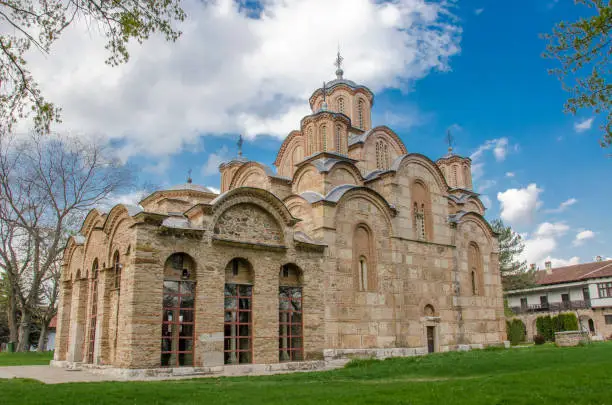
Banjska Monastery. A 14th-century edifice founded by King Milutin, restored in red and white stone in the Raška style. An active monastic community; access requires a protocol we arrange in advance.
Lake Gazivoda (Ujmani). An 11 km² reservoir nestled in the mountains north of Zubin Potok. Swimming possible in July-August, viewpoints from the scenic road that runs along the eastern bank.
When to visit
The best time to visit northern Kosovo runs from late May through early October. In June, July, and August, temperatures in Mitrovica range between 25 and 32 °C during the day, with cooler nights thanks to proximity to the mountains. This is the ideal window for combining city exploration with hiking in the Bjeshkët e Mokrës, where alpine pastures are occupied and trails passable. September and early October offer remarkable autumn colors over beech forests and milder temperatures around 18 to 22 °C, ideal for extended walks.
We advise against the December to March period in mountain areas: snow blocks access to trails on Mount Mokra above 1,200 meters, and temperatures regularly drop below -10 °C at night. Mitrovica remains visitable in winter, but short days and frequent fog in the Ibar Valley limit appeal. April and early May are marked by snowmelt rains and secondary roads sometimes cut off in the Zubin Potok area.
Practical advice
We recommend 2 to 3 days for this region: a full day in Mitrovica (both banks, Trepça, miners' memorial), one to two days for hiking in the Bjeshkët e Mokrës or the Banjska-Gazivoda loop. The logistics hub is Pristina, 40 minutes by road via motorway R6. The most coherent combination begins with Pristina and its center early in your trip, then continues to Peja and the Dinaric Alps via the mountain road through Istog, roughly 1.5 hours of travel with photo stops.
Hotel comfort remains limited on the north side: we work with a few guesthouses in south Mitrovica and one in Zubin Potok, more rustic than what Prizren or Peja offer. This region appeals to travelers curious about geopolitical issues, off-the-beaten-path hiking enthusiasts, and those wanting to understand contemporary Kosovo beyond its Albanian regions. Families with young children and travelers seeking Ottoman heritage will find more to enjoy in Prizren and the south or Gjakova and the west.