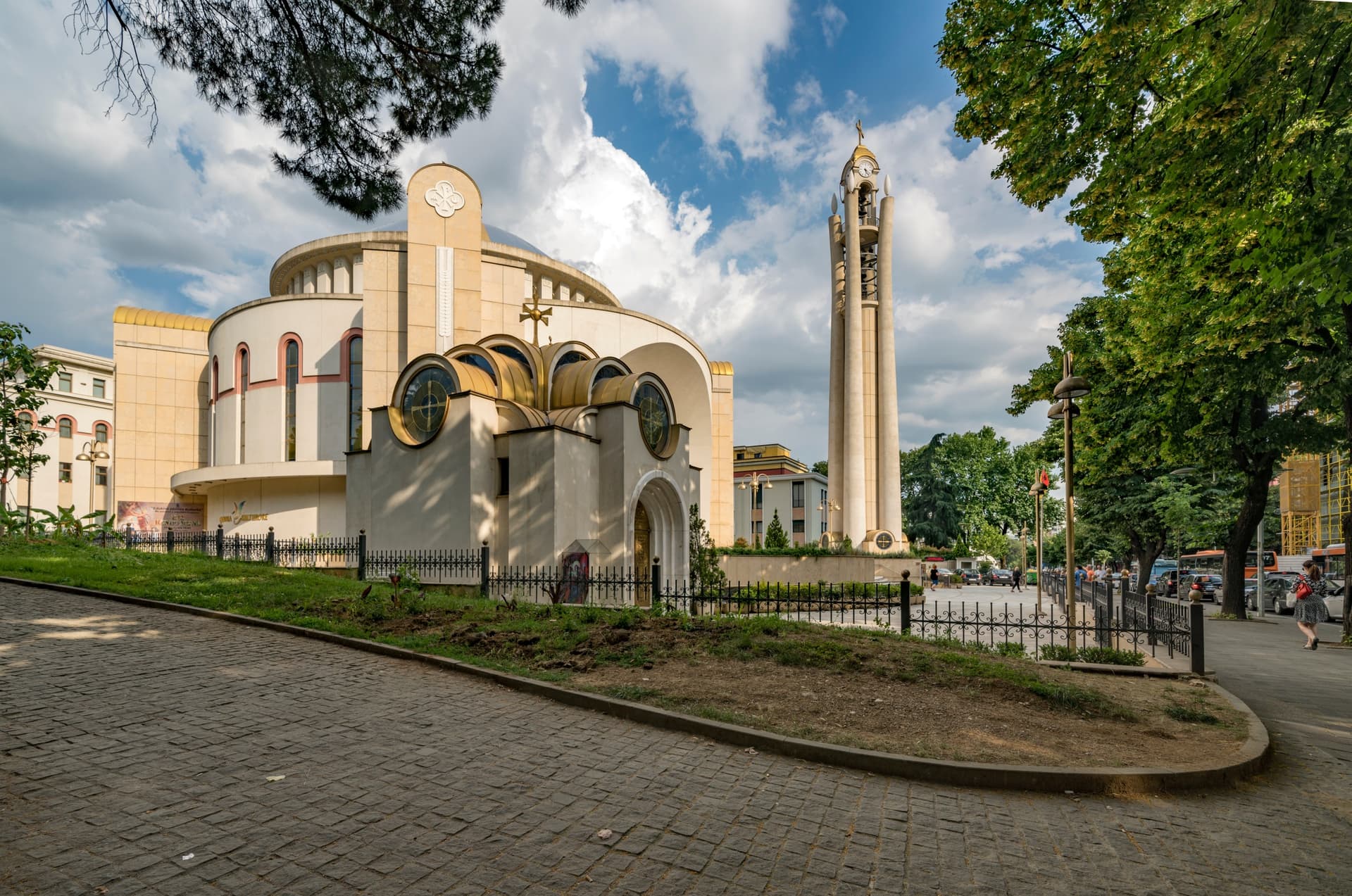
Cathedral of the Resurrection of Christ
Cathedral of the Resurrection of Christ
Inaugurated in 2012 in the heart of Tirana, the Cathedral of the Resurrection of Christ symbolizes the return of Orthodox worship in Albania after half a century of religious prohibition.
The Cathedral of the Resurrection of Christ rises in the center of Tirana, a few minutes from Skënderbeu Square. Inaugurated in 2012, it ranks among the largest Orthodox churches in the Balkans and symbolizes the return of Christian worship to Albania after half a century of religious prohibition. Its blue dome, slender clock tower and contemporary architecture make it immediately recognizable in the urban landscape.
Why visit the cathedral
Three main reasons justify a stop here:
- A modern architectural landmark: refined design by New York-based Papadatos Partnership LLP, departing from traditional Byzantine codes.
- A witness to contemporary Albanian history: the building embodies the break with the communist period during which religion was banned for nearly fifty years.
- Carefully crafted decorative ensemble: frescoes, mosaics and iconostasis executed by monks of Mount Athos.
History and context
Under the Enver Hoxha regime, Albania officially declared itself an atheist state. Religious practice was banned for nearly fifty years and numerous places of worship were razed. The previous Orthodox cathedral in Tirana was among the buildings destroyed, in 1967.
The fall of the communist dictatorship in 1990 opened the way to a revival of worship. The transitional government then assigned a plot of land in the heart of the capital to allow construction of a new cathedral. The project management was entrusted to the Papadatos Partnership LLP firm, based in New York, which had already completed similar projects in the United States.
Construction began in 2004 and lasted eight years. The use of foreign architects and the significant cost of the project—in a country among Europe's poorest—fueled lasting controversy. The inauguration took place on June 14, 2012, on the occasion of the twentieth anniversary of the rebirth of the Albanian Orthodox Church. Archbishop Anastasios of Albania was officially installed there. Since then, the building has housed the seat of the archdiocese of Tirana and the Orthodox Church of Albania.
What to see on site
Exterior and bell tower
The ensemble stands out for its curved lines and unusual volumetry for an Orthodox church. The blue dome rises above 30 meters. Beside it, the clock tower reaches about 46 meters: four pillars converge toward the summit where the bells are housed. In the evening, lighting highlights the bell tower and the access staircase. Just across the way, the 4-Ever Green Tower (85 m) fits into the same modern urban sequence.
Interior
The nave is adorned with frescoes and mosaics executed by monks of Mount Athos. In the center of the dome is the image of the Almighty (Pantocrator). The iconostasis and several lecterns bear other icons from the same workshop. On the floor, on the tiling, the double-headed eagle recalls Albania's coat of arms. Wooden sculptures in the choir stalls complete a décor that is both liturgical and contemporary.
The adjoining complex
The site extends beyond the cathedral. It also includes:
- the Chapel of the Nativity;
- the residence of the Holy Synod;
- a museum and library dedicated to the history of the Albanian Orthodox Church;
- a cultural center hosting lectures and events.
Practical information
- Visiting: open to the public outside of services, generally in the morning and late afternoon. Check the times posted on site the day of your visit.
- Admission: free entry.
- Dress code: appropriate attire required (shoulders and knees covered).
- Duration of visit: allow 30 to 45 minutes for the interior and exterior, more if you extend to the museum.
- Photographs: permitted outside of celebrations, without flash.
How to get there
The cathedral is located in the Dëshmorët e 4 Shkurit sector, near the junction with Myslym Shyri Street. From Skënderbeu Square, it's about a 10-minute walk south. The area is well served by urban buses and easily accessible by taxi from anywhere in the city center.
Nearby attractions
Once your visit is complete, several sites can extend your time in Albania:
- Butrint, an archaeological site inscribed on the World Heritage list in the south of the country.
- Ali Pacha's Castle, a historic Ottoman fortress.
- Germenj National Park, for a nature break.
- Farma Sotira, a popular rural stop in the Korçë region.
Frequently asked questions
Frequently asked questions
Yes, entry is free. Appropriate dress is requested and silence is required during services.
Construction began in 2004 and the cathedral was inaugurated on June 14, 2012, marking the twentieth anniversary of the rebirth of the Albanian Orthodox Church.
The project was entrusted to the New York-based Papadatos Partnership LLP firm, which opted for contemporary volumes: a refined blue dome, a clock tower with four converging pillars and curved lines far removed from traditional Byzantine models.
This is Albania's coat of arms, integrated into the décor of the nave to underscore the national character of the place.
In the Dëshmorët e 4 Shkurit sector, near the junction with Myslym Shyri Street, about 10 minutes on foot from Skënderbeu Square.
Preparing your trip
The cathedral integrates easily into a circuit around the capital and beyond. To learn more, consult our trips to Albania: they combine Tirana, the Ionian coast, ancient ruins and the massifs of the north.
Interested in this visit?
We can include it in your personalised itinerary.