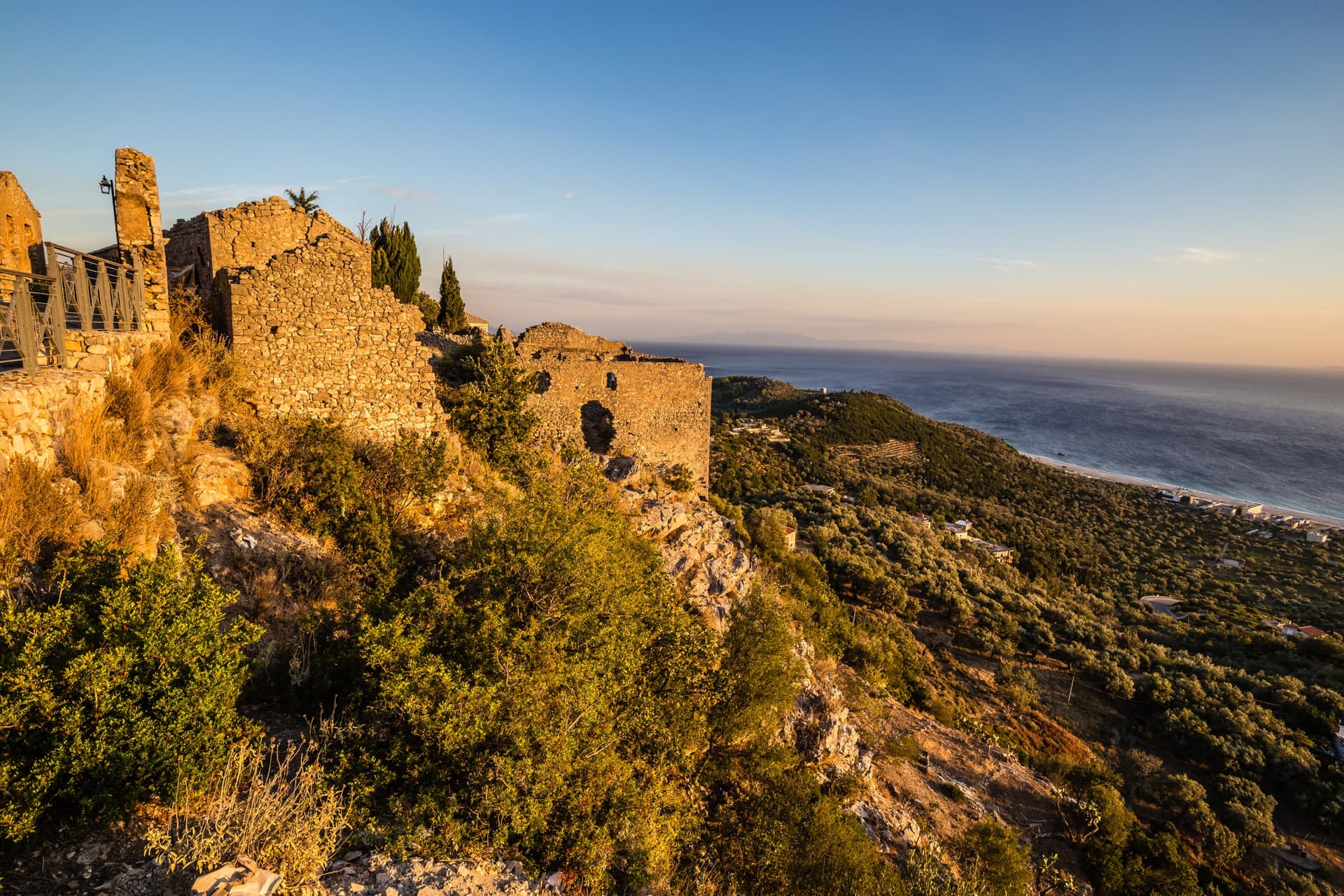
Himara Castle
Himara Castle
Perched 240 m above the Ionian coast, Himara Castle preserves the remains of a Byzantine citadel and several medieval Orthodox churches.
Also known as Babakus, Himara Castle dominates the southern coast of Albanie from a rocky promontory at approximately 240 metres altitude. This fortified site, gradually abandoned from the 16th century onwards, preserves the vestiges of a citadel that was successively a Chaonian stronghold, Byzantine fortress, and Orthodox Christian bastion.
Why visit Himara Castle
The site combines several points of interest within the same perimeter. From a historical perspective, it spans nearly three millennia of occupation, from the earliest ancient fortifications to the still-visible medieval Orthodox churches. From a landscape perspective, its location offers a view west to Livadhi beach, south to Himara bay, and east to the Ceraunian Mountains framing the canyons of Visha and Kole Midhari.
Unlike the restored fortresses in the country's interior, Himara remains a partially ruined site, where paved streets lined with stone houses mingle with religious buildings and collapsed sections of wall. The atmosphere here is more contemplative than museumlike.
History of the site
The castle's origins trace back to the Chaonians, a Greek tribe settled in the Northern Epirus region. A first fortification is attributed to the 8th century BCE, although datings remain debated. The site is first mentioned in written sources in the 1st century CE.
From Rome to Byzantium
Under the Roman Empire, the promontory served to monitor maritime routes linking the Adriatic to the eastern Mediterranean. It was during the Byzantine period, however, that the castle took its most structured form: in the 6th century, Emperor Justinian ordered a major restoration to strengthen defences against external incursions.
Orthodox bastion and bishopric
From the 8th century onwards, the site housed the centre of the Bishopric of Himara. It became an Orthodox Christian stronghold where Albanian families and tribes took refuge, developing their own local alliances. Several churches were built within the walls.
Decline and abandonment
From the 16th century, inhabitants gradually left the citadel to settle lower down, at the site of the modern town of Himara. Better access to resources and the coastline explain this shift. The castle then emptied of its occupants and slowly fell into ruin.
What to see on site
Religious buildings
Several churches remain within the enclosure or in its immediate vicinity:
- The Church of Saint Sergius and Saint Bacchus, dated to the 13th century, is one of the best-preserved buildings on the site.
- The Church of Saint Mary Kasopitra, more modest, testifies to the religious density of the place during the Byzantine era.
- The Greek Orthodox Church of All Saints, located near the SH8 road, completes the ensemble.
Defensive architecture and habitat
The ramparts retain elements typical of Byzantine fortification: thick stone walls, watchtowers, framed gateways. Inside, a network of paved streets serves the vestiges of stone houses, some in ruins, others partially restored.
Cisterns intended for water storage, still visible, illustrate the site's self-sufficiency in case of prolonged siege. A few fragments of Byzantine frescoes and mosaics, damaged, remain in the religious buildings.
Practical information
The castle is freely accessible and wandering within the enclosure requires sturdy footwear: the ground is uneven, sometimes rocky, and certain passages remain steep. Allow approximately 1 to 2 hours to tour the site, longer if you wish to linger over the churches and viewpoints.
A car park and information kiosk are available at the entrance. A guided tour, when available, helps better contextualise the remains and religious episodes linked to the bishopric. In summer, cultural festivals are occasionally organised on site or in the immediate surroundings.
When to go
The site is exposed, with no significant shade, and perched at height. Late spring (May–June) and early autumn (September–October) offer the most comfortable conditions: moderate temperatures, soft light, lower crowds than peak summer.
In July–August, heat can be strong mid-day; favour early morning or late afternoon, which also correspond to the best light for photography. In winter, wind and showers can make the visit uncomfortable, without however closing access.
How to get there
The castle is located about 2.5 km from the town of Himara, on the SH8 road linking Dhermi to Himara. Several options are available:
- By car or taxi from Himara: a journey of just a few minutes to the entrance car park.
- By local bus running on the Dhermi–Himara route, with a short walk from the nearest stop.
- On foot from Himara: the climb is feasible but demanding, due to the slope and uneven surface.
What to see nearby
The castle fits into a wider itinerary along the Albanian Riviera. Livadhi beach, visible from the ramparts, can be reached in a few minutes by car. The village of Dhermi, about twenty kilometres to the north, extends your discovery of the Ionian coast.
To extend your visit to other Albanie sites, you can explore the Karaburun Peninsula, Ali Pacha Castle at Porto Palermo, or, further inland, Mount Gjerë and Germenj National Park.
Frequently asked questions
Frequently asked questions
Including Himara Castle in a trip to Albanie
The castle is well-suited to a stop on the Albanian Riviera, between Vlora to the north and Saranda to the south. To build a complete itinerary combining the Ionian coast, Ceraunian Mountains and historical sites, consult our suggestions for travel to Albanie.
Interested in this visit?
We can include it in your personalised itinerary.