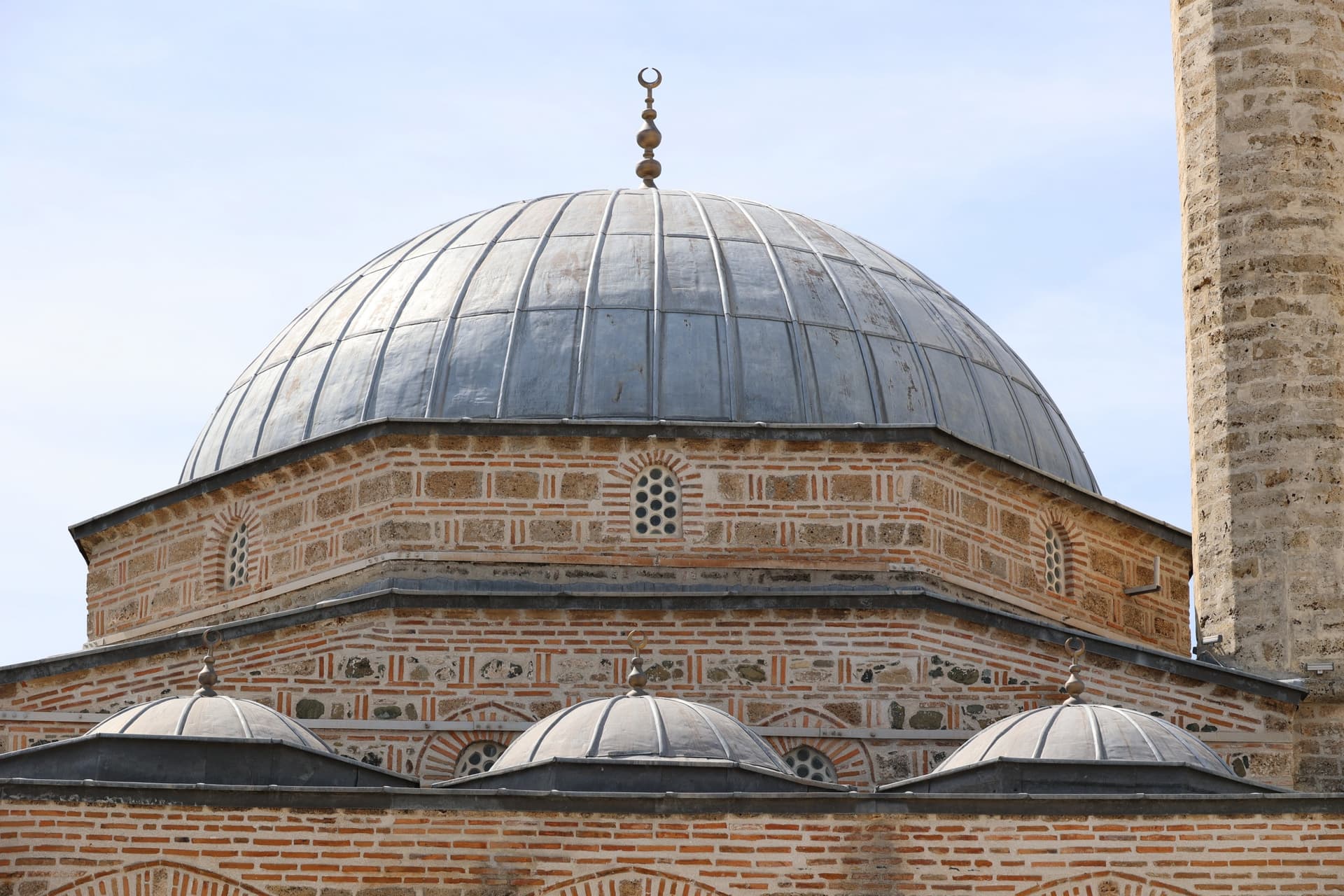
Iljaz Bej Mirahori Mosque
Iljaz Bej Mirahori Mosque
Albania's first classical Ottoman building and the country's oldest domed mosque, erected around 1494 in Korçë by Iljaz Bej Mirahori.
In Korçë, in south-eastern Albanie, the Iljaz Bej Mirahori Mosque is considered the country's first classical Ottoman structure and Albania's oldest domed building. Constructed in the late 15th century, it has endured five centuries of turbulent history, including the communist period when its minaret was destroyed before being rebuilt in 2014.
Why visit the Iljaz Bej Mirahori Mosque
Three key reasons make this structure worth a visit:
- Pioneer architecture: its square prayer hall crowned with a semi-circular dome resting on corner squinches represents the first complete use of this technique in Albanie.
- A witness to Albanian history: the mosque chronicles both Ottoman expansion across the Balkans and religious repression under Enver Hoxha, who declared Albanie the world's first atheist state in 1967.
- An urban landmark in Korçë: with its adjoining clock tower, the ensemble shapes the historic centre and pairs well with nearby museums and the Orthodox cathedral.
History of the structure
The mosque was built around 1494-1495 by Iljaz Bej Mirahori (also known as Imrahor Ilyas Bey), an Ottoman military commander of Albanian origin who served under sultans Mehmet II and later Bayezid II. Following an active military career in the Balkans, he received lands in the region and founded the city of Korçë, which he endowed with a socio-cultural complex comprising the place of worship, his mausoleum, baths and religious annexes (waqf).
The inscription carved above the entrance door specifies his role as patron: "The builder of this noble and beneficial work, Ilyas Bey Mirahori, erected this mosque in the year nine hundred and one" — the date given according to the Islamic calendar. The clock tower was added in 1784 at the entrance to the complex.
During the religious wars that marked the region, the mosque served as a storage facility, which paradoxically saved it from destruction. It was subsequently restored three times (1562, 1831 and 1887), then officially declared a cultural monument in 1948. The 1960 earthquake damaged the minaret and clock tower, but the main structure withstood the impact.
The harshest blow came under Enver Hoxha's communist regime: in the 1990s, the minaret was publicly demolished. It was not rebuilt until 2014, in a style slightly different from the original, with the clock tower itself being reconstructed in 2015.
What to see on-site
The exterior and clock tower
The complex today comprises the mosque, its rebuilt minaret and the clock tower on the façade. The main dome is covered in lead, a material characteristic of the original construction also used for the roof. Above the entrance, Quranic verses traced in lead frame the portal.
The prayer hall
The square-plan hall is covered with a semi-circular dome resting on corner squinches, the first successful use of this technique in Albanie. The mihrab, on the south wall, is decorated with stalactite motifs characteristic of Ottoman art. The pulpit (minbar) stands nearby.
18th-century paintings
The interior decoration features wooden frescoes and 18th-century paintings depicting Medina and Mecca, rare elements that distinguish this structure from other Ottoman mosques in the region. The side walls are pierced by several windows bringing natural light into the prayer hall.
Practical information
- Duration of visit: allow 20 to 40 minutes to tour the building and observe the interior details.
- Access for non-Muslims: visits are generally possible outside prayer times. It's best to arrive mid-morning or mid-afternoon.
- Dress code: shoulders and knees covered, shoes removed at the entrance. A headscarf is recommended for women.
- Admission: free entry; a donation for maintenance is appreciated.
- Photography: permitted outside; inside, ask first and avoid photographing during prayer times.
How to reach Korçë
Korçë lies approximately 180 km south-east of Tirana. Several options allow you to reach the city:
- From Tirana: direct daily buses; allow 4 to 5 hours depending on road conditions.
- From Pogradec (shores of Lake Ohrid): 1 to 1.5 hours by bus or car.
- From North Macedonia: crossing at the Kapshticë border post, accessible from Bitola.
- By rental car: the most flexible option for combining Korçë with surrounding mountain villages. The mosque stands in the pedestrian centre with parking nearby.
What to see nearby
A visit to the mosque pairs easily with other regional sites:
- The Korçë Archaeological Museum, a short walk away, which deepens your historical understanding of the city.
- The Saint Naum Monastery, on the Albanian shore of Lake Ohrid, accessible as a day excursion.
- The Germenj-Shelegur National Park for a nature break in the south-eastern forests.
Frequently asked questions
Frequently asked questions
Plan your journey
The Iljaz Bej Mirahori Mosque naturally fits into an itinerary combining Ottoman heritage, south-eastern lakes and mountain villages. To build a tailor-made trip including Korçë and its surroundings, explore our Albanie journeys.
Interested in this visit?
We can include it in your personalised itinerary.