Berat
Berat
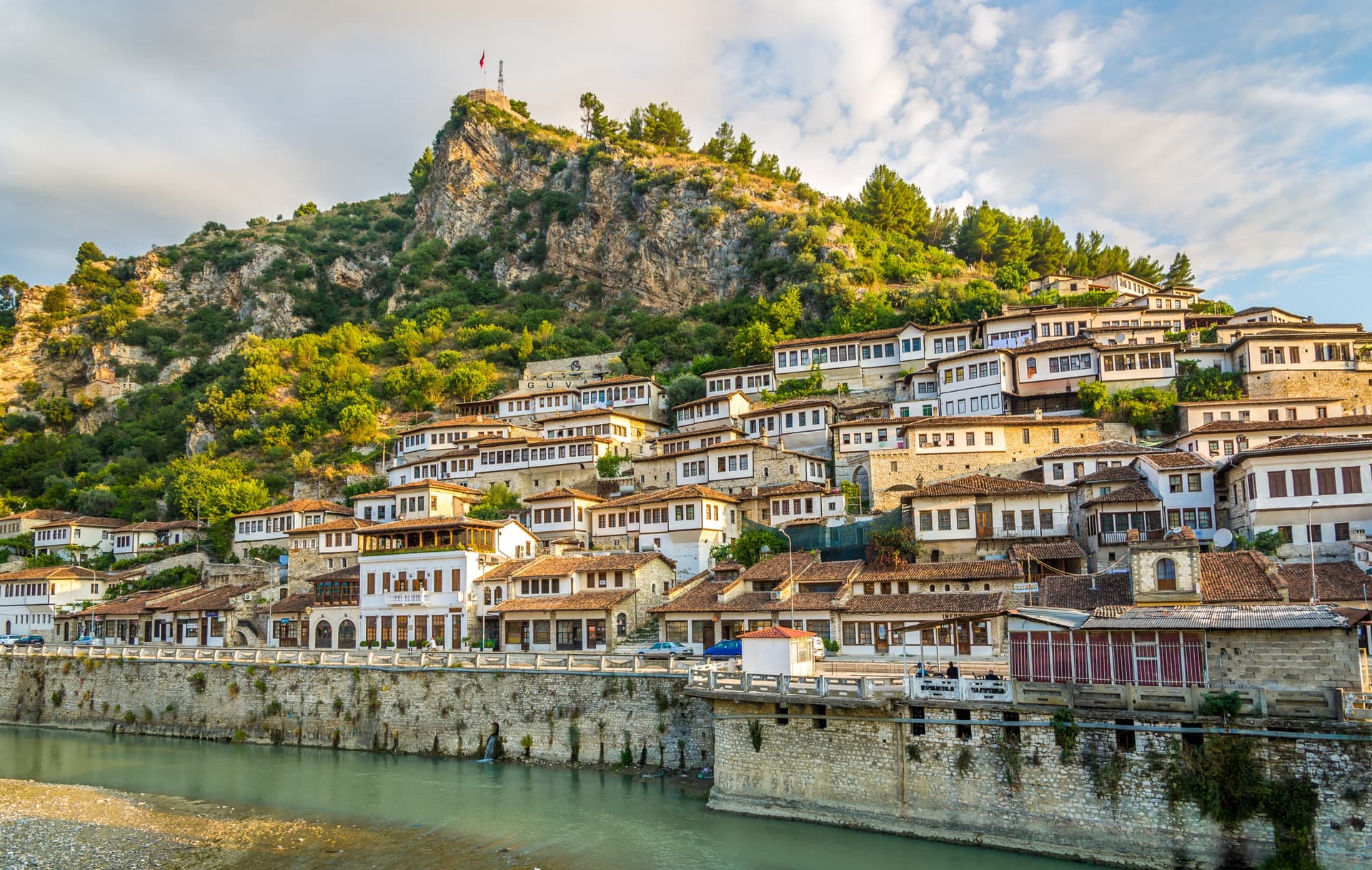
Berat, a UNESCO-listed Albanian city, captivates with its facades adorned with a thousand windows, its still-inhabited citadel, and centuries of coexistence between Christian and Muslim traditions.
The "city of a thousand windows" welcomes you to a rolling region crossed by the Osam River, some fifty kilometers from the Adriatic Sea. Berat is one of Albania's oldest cities, its rich heritage carefully preserved.
History
Berat in Its Early Centuries
Inhabited since the 6th century B.C., Berat in its early years was a fortress of the Dassaretes tribes at the borders of Illyria and Epirus. Following the decline of the Roman Empire—during which it was given the name Pulcheriopolis—the medieval city found itself in the unstable zone of the Byzantine frontier in the Balkan Peninsula. The Slavs who repeatedly assailed the city renamed it Belgrad, or "white city," in the 9th century.
Belgrad evolved into a prominent city of old Bulgaria by the 10th century. There followed a tumultuous period during which it passed successively into the hands of Bulgarians, Byzantines, Neapolitans, Albanians, and Ottomans. The armed forces of the King of Sicily, Charles of Anjou, seized the Byzantine city in 1280. The Albanians of Epirus took control of the region in 1335, only to yield in turn to the Serbian Empire in 1345. The Ottoman Empire conquered Belgrad in 1417, renamed it Berat, and converted the population to Islam. The first mosques were built at this time. The city stagnated until the early 16th century, after which it prospered with the restoration of its fortifications during the Crusades and the development of the woodcraft industry.
Berat remained a predominantly Christian city with very few Muslim buildings in the early 16th century. The local Jewish community grew between 1506 and 1583. Historical sources suggest that Sabbatai Zevi, a false messiah, may have been buried in Berat, which accounts for the presence of a Dönme community within the city in the 17th century. Zevi's disciples considered Berat a sacred pilgrimage site until the 20th century. Some say the supposed tomb of Zevi is hidden within the Berat Sultan Mosque, while other scholars place it in Dulcigno, in present-day Montenegro.
Berat in Contemporary Times
Berat became Albania's largest city, with flourishing economic activity, in the 17th century. Numerous wooden houses were erected. In 1851, most buildings were destroyed by an earthquake—they would later be restored to their traditional appearance. In 1903, a strike broke out in Berat. The population demanded lower taxes and work opportunities in the administrative sector, which had been monopolized by the Ottomans until then. The Germans controlled Albania during World War II, but thanks to the courage of its inhabitants, the local Jewish community escaped the Nazis. These Albanians are inscribed in the Righteous Among the Nations memorial at Yad Vashem in Israel.
Today
Berat is divided into two parts. The old town, whose historic heart was inscribed in the UNESCO World Heritage in 2008, houses most of the popular tourist attractions. The modern city is less rich in historical and panoramic character.
Discovering Ottoman Heritage
The historic quarter of Berat offers a fine example of classical Ottoman cities. Take time to wander through its cobbled streets. Three charming old mosques await discovery in the lower part of the citadel. The Berat Sultan Mosque, erected in the 16th century, is among Albania's oldest Muslim buildings. The houses in this area possess numerous windows, which gave Berat its nickname of the "city of a thousand windows." During your stroll, admire the traditional architectural styles, then enjoy wandering along the banks of the Osam River. A small entrance fee is required to access the upper part of the old town, which contains important remains while offering a superb perspective of Berat.
Perched on a hill, Berat Castle is just over 2,500 years old. Restorations have taken place in the past, including the 13th-century renovation that left the citadel some of its most beautiful elements. Byzantine churches and Ottoman mosques coexist within its antiquated walls, testifying to the exemplary tolerance between different religious and cultural communities in Berat.
Must-See Attractions in Berat
The Berat Ethnographic Museum is housed in a traditional 18th-century Ottoman building. The institution's collection includes objects, tools, and Albanian garments illustrating the way of life of inhabitants in the past. You'll also find furniture, kitchen utensils, and more. Head to the attic to enjoy an exceptional view of Berat, take a stroll in the garden, then visit the Onufri Iconography Museum, which displays the works of the eponymous artist.
For hiking enthusiasts, Berat is an excellent starting point for a trek to Mount Tomor, Albania's highest peak at 2,416 meters altitude. At its summit stands the Bektashi Sanctuary, which remains an important pilgrimage site to this day. The Bogova Waterfalls are also worth the journey.
Climate
The city enjoys a Mediterranean climate. Annual precipitation averages 928 mm.
Berat is served by roads SH72 and SH73, which provide a connection to the city of Fier.
To make the most of the citadel's attractions, opt for walking. Buses are available if you wish to visit the surrounding areas and towns neighboring Berat.
What to Do in Berat?
- Explore Berat's citadel
- Discover the collections of the Berat Ethnographic Museum
- Admire the exhibitions of the Onufri Iconography Museum
- Take a stroll along the banks of the Osam River
- Organize a trek to Mount Tomor, and more
Want to discover this destination?
Our local advisors design your tailor-made trip.