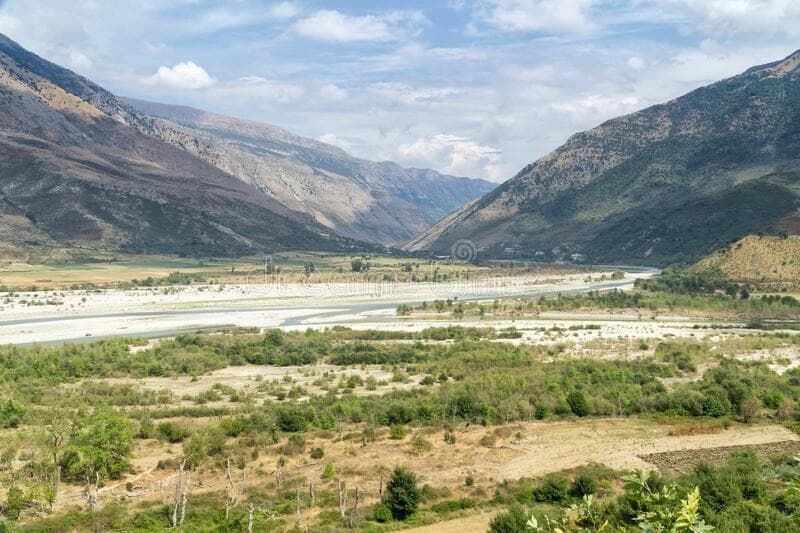
The Drino Valley
The Drino Valley
In southern Albania, the Drino Valley stretches for 50 km lined with the ancient site of Antigone, several monasteries and the fortified city of Gjirokastër.
The Drino Valley, in southern Albania, contains one of the country's highest concentrations of archaeological remains. Over roughly fifty kilometers between Tepelena and the Greek border, it aligns ancient sites, mountain pass monasteries and perched villages, around the river of the same name and beneath the gaze of the fortress of Gjirokastër.
Why visit the Drino Valley
Three main reasons draw travelers to this valley:
- A rare archaeological concentration: around fifteen ancient urban centers recorded, including Antigone, Melani, Palokastra and Andrinople.
- Scattered religious heritage: Early Christian churches, monasteries of Dragot, Cepo and Hundkuq, perched at the entrance to gorges and passes.
- Living agricultural landscape: inhabited slopes, cultivated lands, slate-roofed villages — a rural southern Albania that endures.
A strategically important valley since Antiquity
The valley extends roughly 50 km from the Subashi bridge at Tepelena to the village of Koshovica, at the Greek border. It is bounded to the east by the Lunxheri, Bureto and Mali i Gjerë mountains, and to the west by the Kurveleshi plateau. This corridor geography explains its historical role: it was a major trade route between the interior of Epirus and the Ionian Sea.
The alluvial lands of the Drino enabled prosperous agriculture and livestock raising from early times. To secure this wealth and control the flow of goods, ancient communities fortified their villages in dominant positions. Archaeologists have recorded around fifteen urban centers, among which Antigone, Melani, Palokastra and Andrinople.
Antigone, founded on the Jerma hill on the right bank of the Drino, became an economic, political, social and cultural center from the early 3rd century BCE. Its prosperity was rooted in craftsmanship and commerce. The city was destroyed by Roman consul Aemilius during the Roman campaign in Epirus in the 2nd century BCE, and never recovered.
What to see in the valley
The archaeological site of Antigone
This is the valley's flagship site. The best-preserved remains are found at the southern edge of the site: stretches of fortifications, foundations of dwellings and especially the ruins of an Early Christian church built between the 5th and 6th centuries. Its floor preserves a mosaic depicting Saint Christopher with a dog's head — rare iconography, characteristic of certain Eastern Christian traditions.
Churches and monasteries
The valley is home to several notable religious buildings, often isolated and accessible only by taking a detour:
- The church of Peshkëpi, in the heart of a traditional village.
- The church of Labovë e Kryqit (sometimes cited as Saint Mary Labove), renowned for its Byzantine frescoes.
- The monastery of Dragot, at the entrance to the Tepelena gorges.
- The monastery of Cepo, at the Kardhiq pass.
- The monastery of Hundkuq, at the Çajup pass.
Gjirokastër, the valley's pivot city
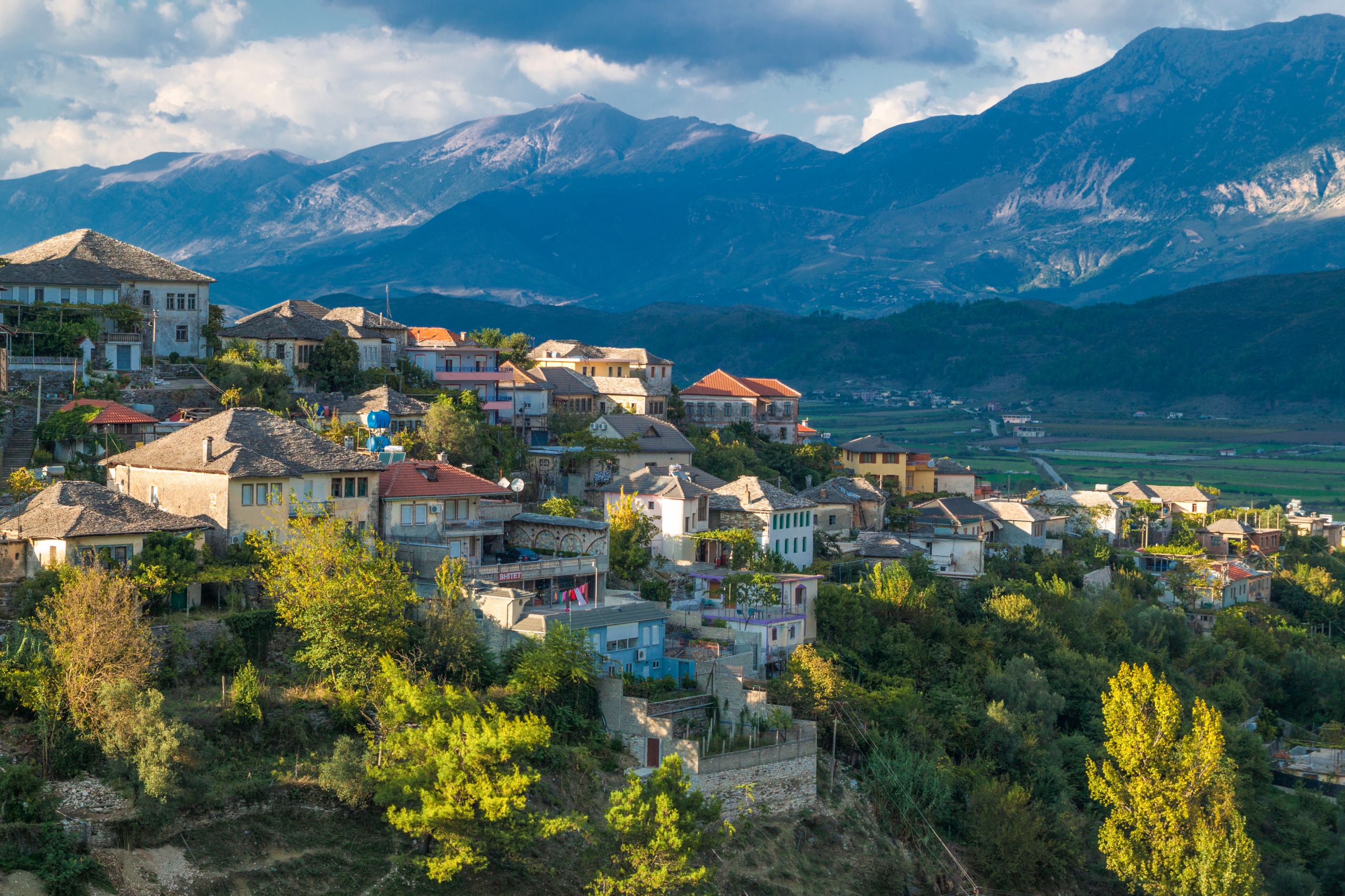
The valley's main population center, Gjirokastër counts more than 2,500 years of history. It preserves an imposing castle and Ottoman-era tower houses with characteristic slate roofs, listed by UNESCO. The city is also the birthplace of Enver Hoxha, leader of communist Albania from 1944 to 1985 — a political legacy present in local memory.
Practical information
- Duration of visit: allow half a day for Antigone alone, a full day to combine the archaeological site and one or two monasteries, two to three days based in Gjirokastër to explore the valley in depth.
- Access to sites: Antigone is open to the public, with a modest entrance fee. Some rural churches require requesting the key from the nearby village.
- Getting around: a car is highly recommended. The secondary roads leading to monasteries are sometimes narrow, but passable outside winter.
- Accommodation: Gjirokastër concentrates the supply (Ottoman guesthouses, hotels). Villages in the valley offer a few family-run guesthouses.
When to visit the Drino Valley
The valley experiences a pronounced Mediterranean climate, with hot summers and precipitation above the regional average. Residents historically settled on the slopes to avoid flooding of the Drino, which can overflow during storms.
- May to June: mild temperatures, green vegetation, river flow still strong. Ideal period for archaeological sites.
- September to October: warm light, grape harvest and agricultural work, pleasant temperatures.
- July-August: early morning visits recommended, sites have little shade.
- Winter: frequent rain, some passes difficult, monasteries sometimes inaccessible.
How to get there
The simplest route passes through Gjirokastër, which serves as a logistical base. The city sits on highway SH4, which links Tepelenë to the north with Dropull to the south, up to the Greek border. Regular buses connect Gjirokastër from Tirana (approximately 4 to 5 hours) and Saranda (approximately 1 hour 30 minutes). Once there, most sites in the valley — Antigone in particular — are accessible by car in less than an hour.
Nearby
Several sites enhance an exploration of southern Albania:
- Mount Gjerë, which borders the valley to the east.
- Germenj-Shelegur National Park, for a high-altitude forest retreat.
- Farma Sotira, a trout farm in the neighboring mountains.
Frequently asked questions
Frequently asked questions
Include the Drino Valley in your journey
The Drino Valley integrates naturally into an itinerary through southern Albania, between Saranda, the Riviera and the highlands. To build a tailor-made trip including Gjirokastër, Antigone and the region's monasteries, explore our trips to Albania.
Interested in this visit?
We can include it in your personalised itinerary.