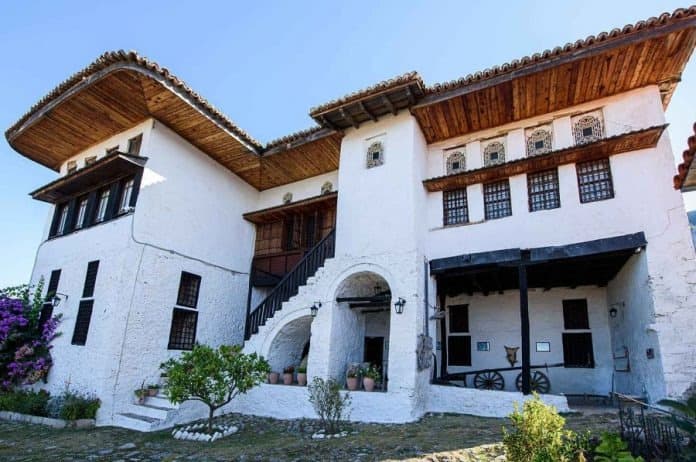
The National Ethnographic Museum of Krujë
The National Ethnographic Museum of Krujë
Housed in an Ottoman residence from 1764 that belonged to the Toptani family, the Krujë Ethnographic Museum showcases Albanian domestic life across 15 rooms.
The National Ethnographic Museum of Krujë occupies an 18th-century Ottoman residence located within the walls of Krujë Castle. Its fifteen rooms, arranged as they were during the time of the Toptani family, trace the domestic life, artisanal trades, and social codes of pre-modern Albania. The museum constitutes one of the major cultural stops when visiting Krujë, complementing the castle and the bazaar.
Why visit the museum
Three elements distinguish this museum from other ethnographic collections in Albania. First, the building itself: a noble residence constructed in 1764, remarkably well preserved, whose architecture directly testifies to Ottoman influence on central Albania. Next, the displayed materials: original furnishings, wall frescoes, finely sculpted woodwork, and everyday objects have remained in place rather than being presented in neutral display cases. Finally, the social perspective it offers, with a clear separation between masculine and feminine spaces, workshop and family quarters, which makes tangible the structures of the 18th-century Albanian household.
History of the Toptani house
The house was built in 1764 and belonged to the Toptani family, one of the influential dynasties of Albanian nobility. Its first owner, Ismail Pashë Toptani, had the residence built on the mountainside to benefit from panoramic views over the surrounding plain. At that time, Albania was integrated into the Ottoman Empire, and the residence's architecture reflects this influence: organization around a courtyard, separation of spaces by gender, elaborate woodwork, and wall frescoes.
The ground floor housed a stable and workshop where tools were made, olive oil and flour were produced, and traditional hats and pottery objects were crafted. This concentration of productive activities made the estate a largely self-sufficient unit. The upper floor, reserved for the family, was accessible only by a removable ladder, a common security device in noble residences of the region in case of attack.
What to see in the museum
The courtyard and outbuildings
The visit begins in the courtyard, where old stone ovens for baking remain, along with beehives also carved from stone, and cages that housed poultry and guard dogs. The ensemble illustrates the domestic functioning of a large 18th-century household.
The stable and workshop
The ground floor displays original agricultural and artisanal materials: an olive oil press, leather-working tools, milling equipment, pottery apparatus. This section highlights the food and material autonomy of the Toptani estate.
The women's chamber
On the upper floor, the women's chamber displays the "Paja," a trousseau that young girls assembled over the years in preparation for marriage: embroidered linens, coverlets, ornamental textiles, and decorative objects intended to furnish the future home. The room illustrates both the practice of hospitality and the role assigned to women in the traditional household.
The men's hall
The men's hall contrasts sharply in its contents: weapons, swords, hunting and combat equipment. A revealing detail of social organization, small windows pierced in the walls allowed women to observe the room without entering it, so they could attend to service without breaking the separation of spaces.
Woodwork, frescoes, and Turkish bath
Throughout the house, wall frescoes with floral and geometric motifs have been preserved, as have original furnishings and woodwork with finely carved patterns. A small Turkish bath (hammam) integrated into the residence completes the visit: it was used by the inhabitants and their guests.
Practical information
- The museum is open year-round, closed Mondays. Hours vary by season; it is best to check on-site or with the tourist office before your visit.
- Plan 1 to 1.5 hours to tour the fifteen rooms without rushing.
- Admission remains modest, payable in Albanian leks (cash recommended).
- Guided tours may be available; the availability of an English-speaking guide is not guaranteed—plan for an English-speaking or Italian-speaking guide.
- The upper floor is made of old wood: comfortable shoes recommended.
How to get there
Krujë is located approximately 35 km north of Tirana. From the capital, buses and minibuses depart regularly from the northern bus station and reach Krujë in 45 minutes to 1 hour depending on traffic. Once in the town, the single main street, lined with artisanal bazaars, leads directly to the castle walls where the museum is found. The ascent is made on foot from the parking area. With a rental car, allow less than an hour from Tirana or from Nënë Tereza International Airport.
Nearby attractions
The museum is part of a cultural complex concentrated on Krujë's hilltop. A few steps away, the Skanderbeg Museum, dedicated to the Albanian national hero who resisted the Ottomans from this same fortress, occupies the reconstructed castle. The Krujë bazaar, below, retains its Ottoman atmosphere and remains one of the best places in the country for traditional crafts: carpets, copperware, embroidered textiles. To extend your journey through Albania, you might consider natural stops such as Farma Sotira in the southeast, Germenj-Shelegur National Park, or mountain ranges like Mount Gjerë and Mount Kokojka. On the coast, the Karaburun Peninsula offers a striking contrast with Krujë's mountainous hinterland.
Frequently asked questions
Frequently asked questions
One to one-and-a-half hours are sufficient to tour the museum's fifteen rooms and courtyard. Combined with the nearby Skanderbeg Museum and the bazaar, plan a half-day in Krujë.
Yes. Krujë is 35 km from Tirana and is easily reached by bus, minibus, or car in less than an hour. It is one of the most common excursions from the capital.
The museum is located within the walls of Krujë Castle, next to the Skanderbeg Museum. The artisanal bazaar is below, on the access path. All three sites can be visited in a single day.
Extending your journey
The Krujë Ethnographic Museum makes an excellent entry point into Albanian material culture. To integrate this stop into a broader itinerary combining Ottoman heritage, mountains, and coastline, consult our suggestions for travel in Albania.
Interested in this visit?
We can include it in your personalised itinerary.