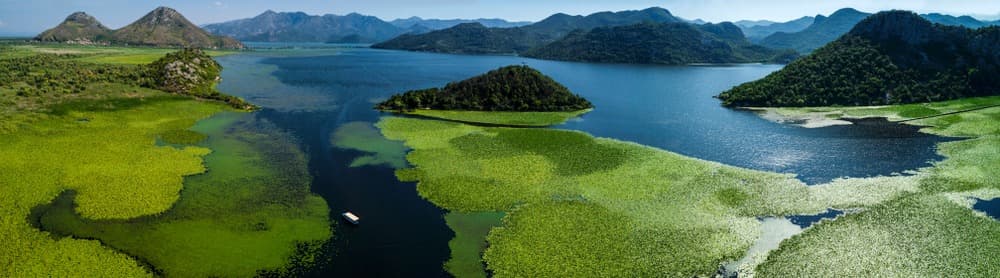
Lake Shkodra
Lake Shkodra
The largest lake in the Balkans, shared between Albanie and Montenegro, Lake Shkodra concentrates 270 bird species and biodiversity designated a Ramsar site.
Lake Shkodra (or Lake Skadar) stretches across the border between Albanie and Montenegro, covering approximately 370 km² on average. A nature reserve on the Albanian side since 1983 and a Ramsar site since 1996, it harbors one of Europe's most significant bird concentrations and a historical heritage dating back to the 11th century.
Why visit Lake Shkodra?
Often presented as the largest lake in the Balkan peninsula, Lake Shkodra combines three assets rarely found together. First, exceptional biodiversity: 270 bird species, around fifty fish species (including 18 endemic) and over 25 rare plant species. Second, a landscape shaped by the spring floods of the Morača river, which can swell the lake's surface to 530 km². Finally, direct accessibility from Shkodra, an Albanian city situated on its southern shore.
The site suits ornithologists and hikers equally well, as it does cyclists or travelers seeking a peaceful half-day in a traditional wooden boat.
History and formation of the lake
Lake Shkodra is an ancient lake of tectonic origin. Its basin formed during the Cenozoic era, following complex folding and faulting in the High Karst zone. Block collapses during the Paleogene and Neogene prepared the terrain; during the Miocene and Pliocene, the sea invaded the Zeta plain as far as Podgorica, submerging the surrounding freshwater bodies. Gradual separation from the sea during the younger Pliocene partly explains the degree of endemism observed today.
Human presence around the lake is attested to from early times. The first written references date to the 11th century, during the genesis of Montenegro's first dynasty. In the early 15th century, Roman Catholic monuments built on the shores were gradually taken over by the Orthodox Church. The region subsequently came under Turkish control from 1478 to 1878, until Montenegro's liberation. On the Albanian side, the lake portion was declared a nature reserve in 1983; the entire site was designated a Ramsar site in 1996.
What to see and do
Europe's reference birdlife
With its 270 recorded species, Lake Shkodra ranks among Europe's greatest bird reserves. Notable species include:
- Dalmatian pelicans, the site's emblematic species;
- cormorants and rare yellow herons;
- migratory species: great egrets, ducks, spoonbills.
The waters also harbor around fifty fish species (sturgeon, eel, carp, bass), including 18 endemic, as well as 50 freshwater snail species, a third of which are also endemic. An otter, facing extinction, may occasionally be spotted along the banks.
Protected flora
Over 25 rare or threatened plant species are present: Dalmatian crocus, water chestnut, several protected orchids. The marshes are covered with yellow and white water lilies, bamboo borders some shores, and the surrounding forests are dominated by oak and white willow.
Activities on site
- Cruises in traditional wooden boats, sometimes equipped with reed parasols;
- Hiking along 11 marked trails, with maps distributed at visitor centers;
- Cycling on old roads and paths;
- Kayaking and swimming in natural pools nearby;
- Fishing permitted from June to March, provided you obtain a license at the visitor centers in Virpazar or Vranjina;
- visits to neighboring vineyards, birthplace of the Montenegrin red wine Vranac.
Practical information
Lake Shkodra is accessible year-round. Plan for a half-day for a simple cruise, a full day if you combine boating and hiking. Boat excursion rates remain moderate, but vary by season and duration: inquire directly at visitor centers or with local operators in Shkodra.
Visitor centers on the Montenegrin side are located in Virpazar and Vranjina; on the Albanian side, departures are organized from Shkodra and riverside villages of Shiroka and Zogaj.
When to go?
Two periods are particularly suitable:
- Spring (April to June), when vegetation greens, floods reach their peak and migratory birds return to nest;
- Autumn (September to October), for the colors of surrounding forests and milder temperatures on the water.
Summer remains feasible but can be hot and more crowded. In winter, some activities (fishing, cruises) wind down, though bird watching retains its appeal.
How to get there
From Albanie: Shkodra is the closest city to the lake. It is served by bus from Tirana (approximately 2 hours) and the rest of the country. From Shkodra, allow a few minutes by taxi, rental car or bicycle to reach the lake's southern shores and park entrance.
From Montenegro: Trains and buses serve Virpazar (less than a kilometer from the visitor center) from Podgorica, Bar and Sutomore.
Nearby attractions
- Shkodra and its Rozafa Fortress, the logical starting point on the Albanian side;
- Lake Koman, a few hours to the northeast, for a ferry crossing through the Albanian Alps;
- Castle of Krujë, on the route towards Tirana;
- Germenj National Park, to extend the nature experience in the south of the country.
Frequently asked questions
Frequently asked questions
Both: the lake is shared between Albanie (southern shore) and Montenegro (northern shore), which occupies its largest portion. The Albanian part has been a nature reserve since 1983; on the Montenegrin side, it is a national park. The entire site has been designated a Ramsar site since 1996.
Spring, particularly from April to June, is ideal for observing nesting and migratory species, including Dalmatian pelicans. Autumn offers a second interesting window during the passage of migrants.
Yes. Fishing is permitted from June to March, but requires a license to be obtained from the visitor centers in Virpazar or Vranjina, on the Montenegrin side.
A half-day is sufficient for a boat cruise. Plan for a full day if you wish to combine boating, hiking along marked trails and visiting a riverside village or neighboring vineyards.
Yes. Several old roads and trails encircle the lake and are suitable for cycling. Visitor centers offer maps and route advice, and bike rental is available from Shkodra or Virpazar.
Plan your trip
Lake Shkodra integrates easily into an itinerary between northern Albanie and Montenegro. To build a tailor-made stay including Shkodra, the lake and the Albanian Alps, consult our trips in Albanie.
Interested in this visit?
We can include it in your personalised itinerary.