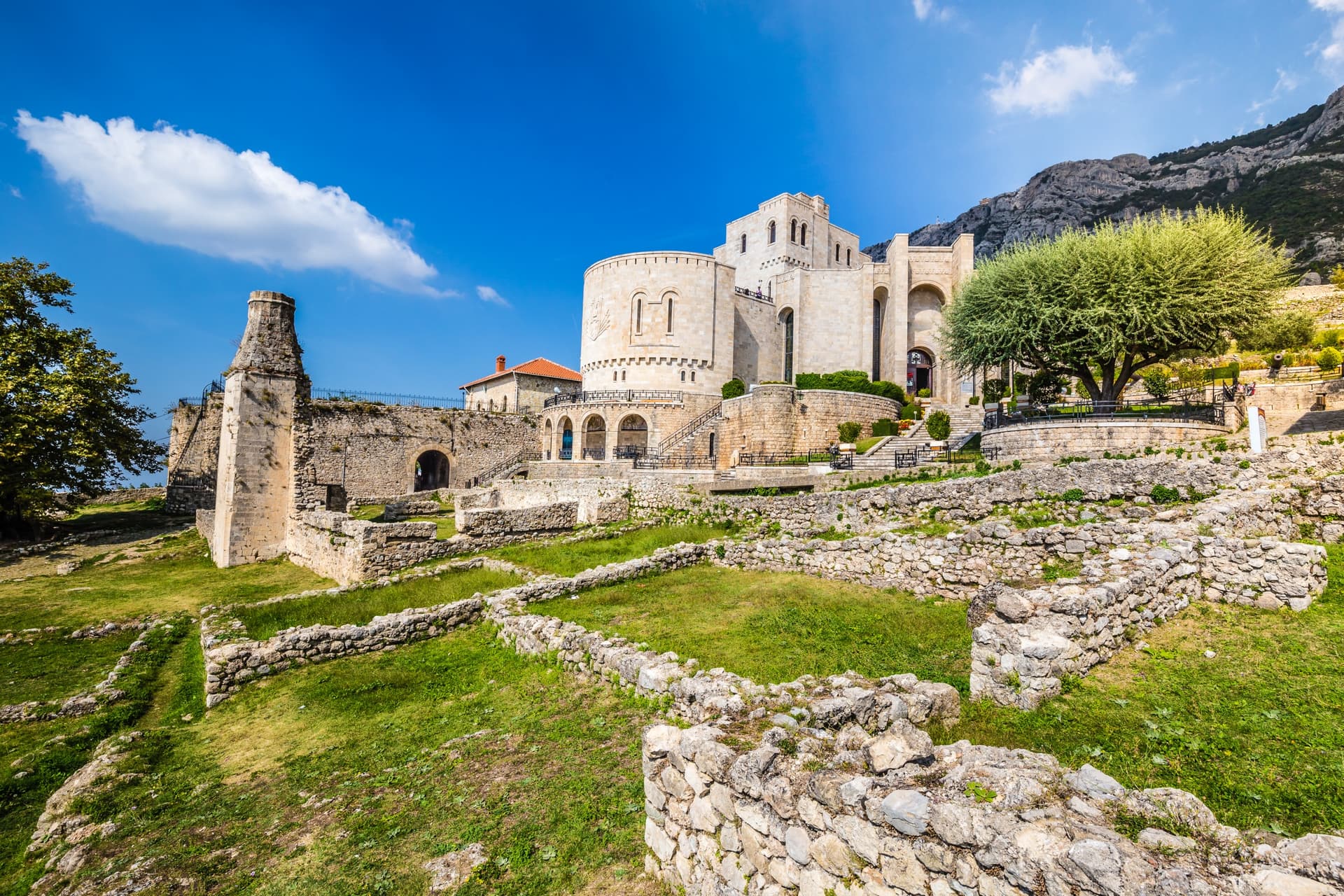
Krujë Castle
Krujë Castle
Perched on a hilltop overlooking Krujë, Skanderbeg's fortress withstood three Ottoman sieges in the 15th century. Today: two museums and a historic bazaar.
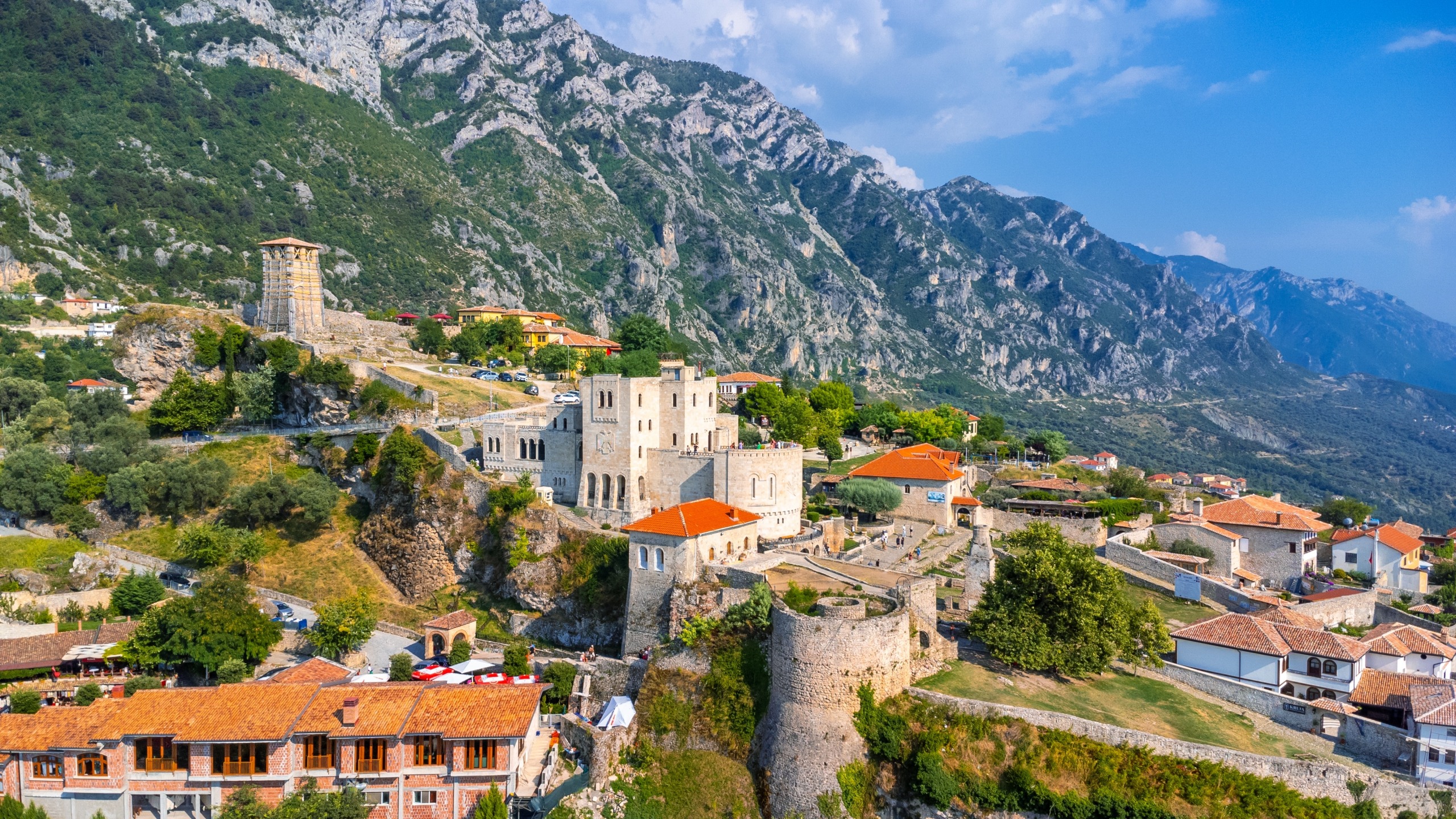
Overlooking the town of Krujë, some twenty kilometers north of Tirana, Krujë Castle stands as a testament to Albanian resistance against Ottoman expansion in the 15th century. The stronghold of Skanderbeg, a national hero, today houses two museums and preserves the remnants of a history that shaped the nation's identity.
Why visit Krujë Castle
The site offers three complementary attractions. First, its historical significance: this is where Skanderbeg held back Ottoman armies for more than twenty years, making Krujë a national symbol. Second, its museums—the Skanderbeg Museum and the Ethnographic Museum—which provide a comprehensive narrative. Finally, its heritage value through the traditional bazaar and Ottoman-era alleyways of the old town leading to the fortress. Its proximity to Tirana makes it an ideal half-day to full-day excursion, requiring minimal logistical planning.
History
The town of Krujë was proclaimed capital of the Principality of Arbër in 1190, the first form of medieval Albanian statehood. Falling under Ottoman rule in the early 15th century, it was liberated in 1443 by Skanderbeg and the League of Lezhe, an alliance of Albanian nobles.
The castle, built in the 5th century, then became the bulwark of resistance. Between 1450 and 1467, the fortress withstood three successive Turkish assaults, defended by a garrison estimated at approximately 3,000 men. Skanderbeg died in 1468. Ten years later, in 1478, Krujë fell during the siege led by Mehmed II "The Conqueror", becoming part of the Ottoman Empire for centuries to come.
The site's history extends into the 20th century: during World War II, Krujë became a center of armed resistance led by Abaz Kupi. The castle appears on Albanian banknotes: on the reverse of the 1000-lek note between 1992 and 1996, then on the 5000-lek note since 1996.
What to see on site
The George Castriot Skanderbeg Museum
Designed by Enver Hoxha's daughter in a neo-medieval style, the museum traces the life of the Albanian leader and the 15th-century Albanian-Ottoman wars. Its iconic piece remains the replica of Skanderbeg's coat of arms, featuring his helmet topped with a goat's head and his sword. Maps, facsimiles of diplomatic correspondence with European powers, and murals round out the exhibition.
The National Ethnographic Museum
Located lower on the site, the National Ethnographic Museum of Krujë occupies a traditional 18th-century house that once belonged to the Toptani family. It documents the domestic self-sufficiency of the era: food production, tool-making, a private hammam, murals, and carved woodwork. The displayed pieces span periods ranging from 60 to 500 years.
Ottoman Mosque and Bazaar
Within the fortress walls stand the ruins of an Ottoman mosque built under Mehmed II. Along the path to the castle, the traditional Krujë bazaar, 450 years old, once boasted up to 150 merchants at its height. Rebuilt after several fires, it today groups artisan workshops and antique shops where you can find textiles, copper items, and Ottoman-era pieces.
Practical information
- Duration of visit: allow 2 to 3 hours to explore the castle, both museums, and the bazaar.
- Admission: paid entry to the museums at moderate rates. Access to the fortress grounds and bazaar is free.
- Opening hours: open year-round, typically closed one day per week. Check locally before visiting.
- Accessibility: paved uphill climb to the entrance; wear sturdy shoes.
When to visit
Krujë can be visited year-round, though certain seasons are more pleasant. Spring (April-June) and early autumn (September-October) offer mild temperatures and clear views from the ramparts across the coastal plain. Summer can be warm at midday, though the altitude keeps temperatures moderate. Winter brings coolness and possible fog, but also fewer crowds.
How to get there
Krujë is located approximately 20 km north of Tirana, roughly 45 minutes to 1 hour's drive depending on traffic. By car, take the SH1 highway and then a secondary road to the lower town; parking is available before the climb toward the bazaar.
By public transport, buses and minibuses depart from Tirana's market area, near the main railway station, at regular daytime intervals. The terminus is at the foot of the old town, from where you can access the bazaar and castle on foot via a paved street.
Nearby attractions
To extend your exploration of historic Albanie, several sites complement a visit to Krujë:
- Butrint, an ancient city and UNESCO World Heritage site in the south.
- Ali Pacha Castle, another major Ottoman fortress in Albanie.
- Germenj-Shelegur National Park for a nature-focused contrast.
Frequently asked questions
Frequently asked questions
Gjergj Kastrioti, known as Skanderbeg (1405-1468), is the Albanian national hero. A feudal lord trained at the Ottoman court, he defected in 1443 to found the League of Lezhe and led resistance against the Ottoman Empire for 25 years from Krujë.
The ramparts and clock tower are partly medieval and Ottoman. The Skanderbeg Museum building, however, is a 20th-century construction designed in neo-medieval style and inaugurated in 1982.
Plan 2 to 3 hours to comfortably explore the castle, the Skanderbeg Museum, the Ethnographic Museum, and wander the bazaar. A half-day trip from Tirana is sufficient.
Include Krujë in your trip
Krujë fits naturally into an itinerary combining Tirana, the mountainous north, and the Adriatic coast. To build a custom journey incorporating this historic site, explore our Albanie travel packages.
Interested in this visit?
We can include it in your personalised itinerary.