Bënja Thermal Springs
Bënja Thermal Springs
Six free thermal pools along the Langarica river, dominated by the 1760 Ottoman bridge and Nemërçka mountains, 10 km from Petran.
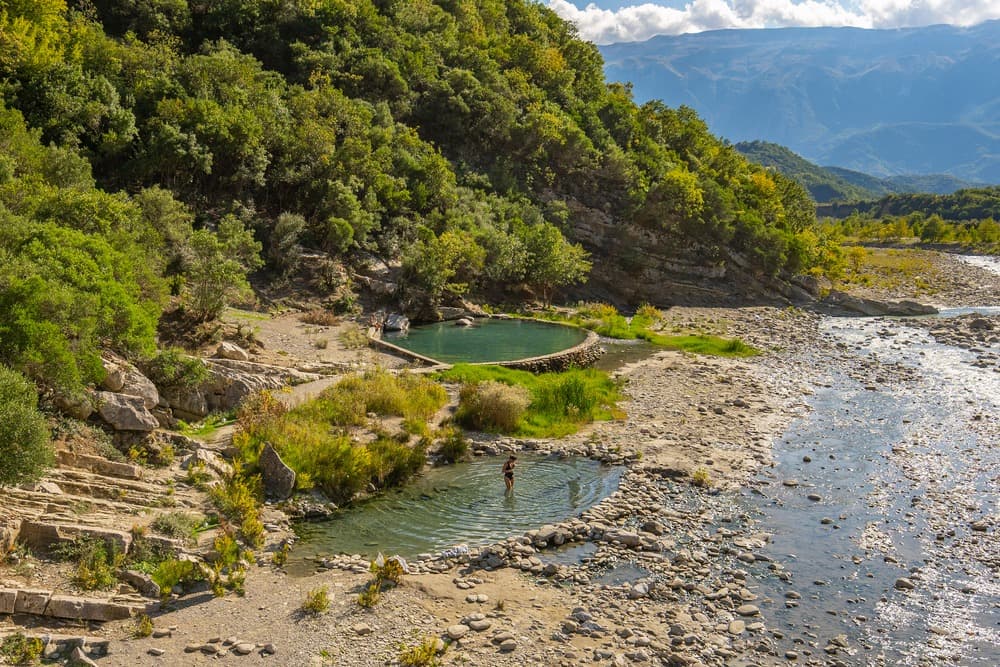
The Bënja thermal springs line six stone basins along the Langarica river, roughly ten kilometers from the village of Petran, in southern Albanie. Hot sulfurous waters, an 18th-century Ottoman bridge, and the Nemërçka mountains as backdrop: the site combines free thermal bathing with canyon scenery, without heavy tourist infrastructure.
Why visit Bënja springs
- Free open-air baths: six natural pools freely accessible, no ticket or opening hours required.
- Hot sulfurous waters: temperature hovers around 28 °C, fed by geothermal gradient.
- Unspoiled setting: 0.6 hectares designated a protected zone since 2002, at the foot of the Nemërçka mountains.
- Ottoman heritage: the "judge's bridge," built in 1760, marks the entrance to the site.
- Mud bath: a muddy pool rounds out the thermal experience.
History of the site
The thermal waters of Bënja spring from a geothermal gradient that charges them with sulfur. Their use is ancient, but access to the site today still comes via the "judge's bridge," an Ottoman structure dating to 1760 that spans the Langarica.
Modern development of the springs began in the 1990s, then was abandoned following disputes between the parties involved. Local residents then shaped the stone basins visible today by hand, and access has remained free. The site was designated a protected zone in 2002, covering an official area of 0.6 hectares.
What to see and do
The six pools
Six thermal basins succeed one another along the riverbank. The water, at around 28 °C, then overflows into the cold waters of the Langarica, creating at the confluence a contrasting bathing zone. The most frequented pools are those near the bridge; the quietest are found higher up, about ten meters from the stream, slightly set back from the main path.
The mud pool
A muddy pool, further downstream, allows for a mud bath before rinsing in the thermal waters and then in the cold river.
The judge's bridge and the landscape
The 1760 Ottoman bridge, arched in its distinctive form, remains the site's strong heritage feature. Around it, the scenery combines light pebbles, turquoise waters of the Langarica, delicate waterfalls, caves and the entrance to the Langarica canyon, accessible on foot from the pools.
Practical information
- Access: free and open, no ticket office.
- Bathing duration: limit each immersion to around ten minutes due to sulfur content, which strongly invigorates the body. Plan rest periods between baths.
- Contraindication: sulfurous baths are not recommended for people with heart conditions.
- Equipment: no services on site. Bring swimsuit, towel, drinking water, footwear suitable for pebbles and snacks.
- Accommodation: camping is tolerated in the surrounding area; otherwise, Përmet, nearby, offers guesthouses and small hotels.
When to visit
The site can be visited year-round thanks to the region's Mediterranean climate: warm and temperate summers, mild and rainy winters. The warm season (May to September) remains the most practical: the river is less deep, the confluence more accessible and the trails dry. In winter, the hot baths are pleasant by contrast, but floods on the Langarica can submerge the lower pools. Summer weekends are popular with Albanian families; aim for early morning or late afternoon for quieter visits.
How to get there
The springs are located about 10 km from Petran, in southern Albanie. The region has no airport: from abroad, you land in Tirana, then head south by road. Count a full day of travel by bus from the capital, or roughly half a day by car, via Berat or Gjirokastër.
On site, a rental car remains the most flexible option. Local buses connect Përmet to Tirana and other towns in the south; from Përmet, a taxi or organized transfer gets you to the springs. The last kilometer, after the Ottoman bridge, is done on foot.
To see nearby
- Langarica canyon: just upstream from the pools, accessible on foot in the river.
- Bredhi i Hotoves National Park: fir forests and hiking trails, east of Përmet.
- Ali Pacha's Castle: historic fortress of the region.
- Berat Castle: heritage stop on the route from Tirana.
- Butrint: major archaeological site in southern Albanie, UNESCO-listed.
Frequently asked questions
No. The pools are maintained by locals and access remains free, with no opening hours or ticket office.
Around ten minutes per bath. The waters are rich in sulfur and strongly invigorate the body: it is advised to rest between two immersions.
Sulfurous baths are not recommended for people with heart conditions. If in doubt, seek medical advice before bathing.
The springs hover around 28 °C year-round, fed by a geothermal gradient. At the confluence with the Langarica, the contrast with the river's cold water is very striking.
Camping is tolerated around the springs. For more comfort, Përmet, a few kilometers away, offers guesthouses and small hotels.
Including Bënja in a trip to Albanie
Bënja springs fit naturally into an itinerary in the country's south, between Berat, Përmet, Gjirokastër and the Ionian coast. To build a tailor-made stay including the thermal baths, Langarica canyon and nearby sites, consult our trips to Albanie.
Interested in this visit?
We can include it in your personalised itinerary.