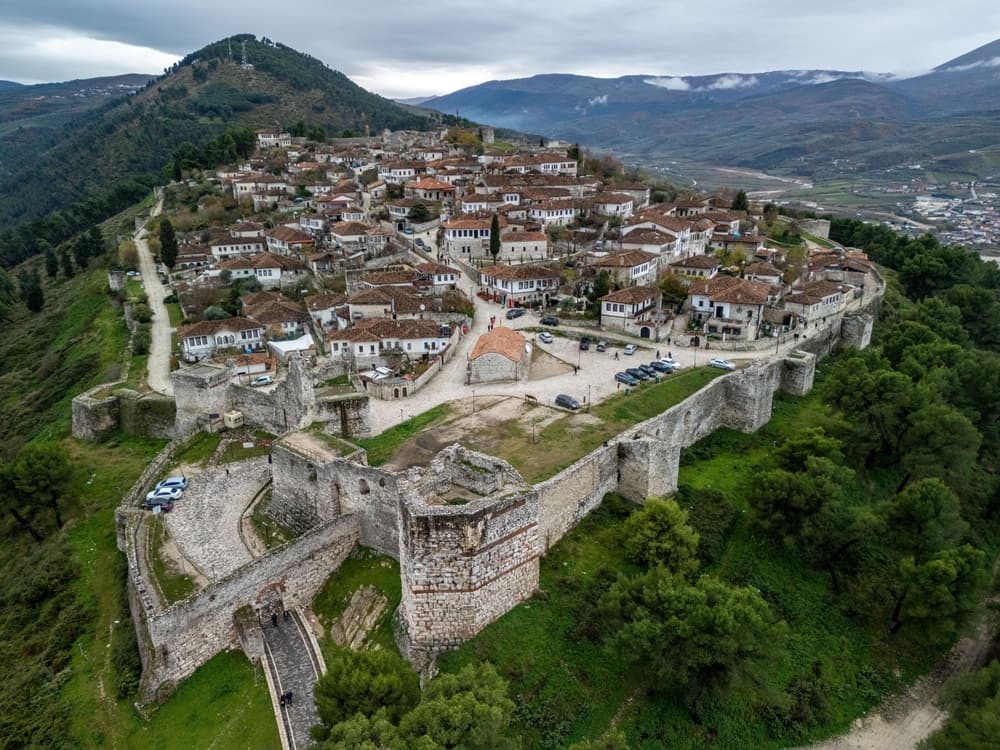
Berat Castle
Berat Castle
An inhabited fortress overlooking the city of a thousand windows, Berat Castle blends Illyrian remnants, Byzantine churches and Ottoman architecture.
Perched on a rocky hillside above the Osumi valley, Berat Castle dominates the city nicknamed the "city of a thousand windows". This fortified site, listed as a UNESCO World Heritage Site along with Berat's historic centre, stands apart from other Albanian citadels in one essential detail: it remains inhabited. Families live within its walls, in traditional houses scattered among Byzantine churches, ruined mosques and ancient ramparts.
Why visit Berat Castle
Berat Castle is not a frozen archaeological site. It is a residential quarter in its own right, where you encounter inhabitants going about their daily lives amid the ruins. This rare European feature gives the visit a living dimension. Added to this is exceptional historical layering: Illyrian, Roman, Byzantine and Ottoman. The site also houses the Onufri Museum, dedicated to Byzantine icons by the eponymous 16th-century painter, installed in the former Cathedral of the Dormition.
History of the castle
Dating from the 4th century BC, the castle was founded by the Illyrians before being destroyed by the Romans in 200 BC. Its strategic position, on the axis crossing central Albania, made it a coveted control point.
The fortress was rebuilt under Byzantine Emperor Theodosius II in the 5th century, then reinforced by Justinian I in the 6th century. In the 13th century, Michael I Komnenos Doukas, Despot of Epirus, undertook a new reconstruction, which resulted in much of the walls still visible today. At its peak, the enclosure was home to over 6,000 inhabitants. Today, a few hundred people still live there, in houses often converted into accommodation.
What to see inside
The Byzantine churches
The castle contains several remarkable religious buildings. The Church of the Holy Trinity, dated to the 13th century, occupies a rocky outcrop facing Mount Shpirag and the Osumi river; it preserves inscriptions from the 14th century. The Church of Saint Demetrius contains 17th-century frescoes. The Church of Saint Mary of the Blachernae, one of the oldest on the site, is also adorned with frescoes.
The Onufri Museum
Housed in the former Cathedral of the Dormition of the Virgin, the Onufri Museum holds a collection of Byzantine and post-Byzantine icons. It is one of Albania's most important collections for understanding the local iconographic school of the 16th century.
Ottoman vestiges
The Red Mosque, largely in ruins, preserves a remarkable minaret. Inside the main fortress, you can also make out the foundations of the White Mosque. These remains recall five centuries of Ottoman presence in the region.
Constantine's head and the cistern
On the walls, a monumental sculpture represents the bust of Constantine the Great. Nearby, an ancient cistern carved into the rock served as a water supply during sieges; an opening today allows you to observe its interior.
Viewpoints
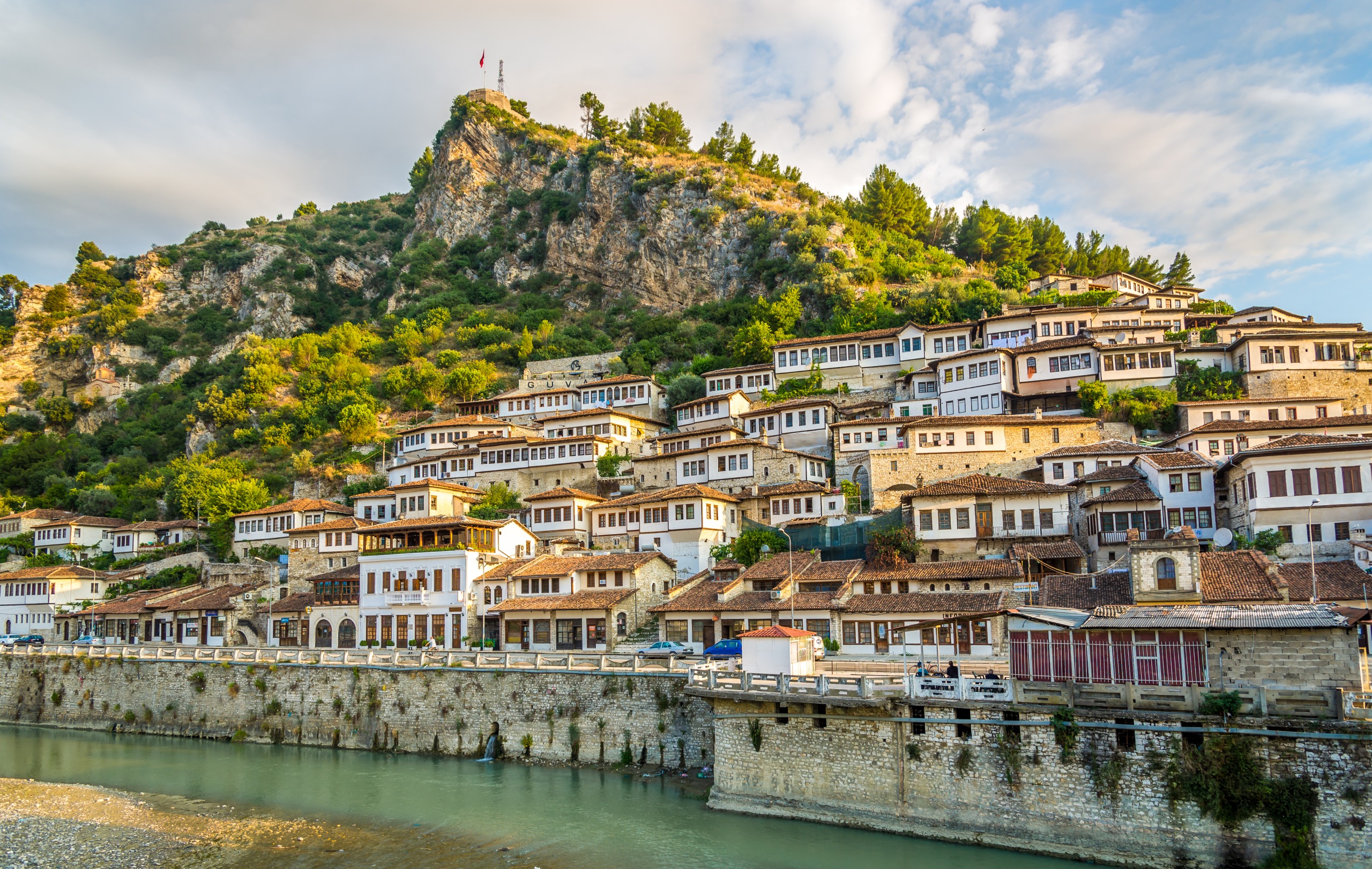
From the ramparts, you can see the Mangalem quarter with its tiered houses, the Ottoman bridge of Gorica, and the Osumi valley. The main fortress offers a 360° panorama over the city and surrounding countryside.
Practical information
- Duration of visit: allow 2 to 3 hours to explore the enclosure, plus 30 to 45 minutes for the Onufri Museum.
- Admission fee: a modest entrance fee is requested at the main gatehouse; the Onufri Museum requires a separate ticket.
- Opening hours: the Onufri Museum follows daytime hours; the castle enclosure, being a residential quarter, remains accessible outside these times via public paths.
- Footwear: the cobblestones are irregular and some passages steep; wear sturdy shoes.
- Accommodation within the walls: several guesthouses occupy former dwellings within the enclosure, for an immersive experience.
- Respect for residents: as the castle is inhabited, be discreet in the alleyways and avoid entering private courtyards.
When to go
Berat experiences a continental climate: hot, dry summers and cool, humid winters. The most pleasant period extends from April to June and from September to mid-October, when temperatures are mild and light is favourable for photography. In July and August, the heat can make the climb challenging mid-day; visit early in the morning or late afternoon. Winter offers a quieter atmosphere but some churches may be closed.
How to get there
The castle is located about 3 km from Berat's town centre, accessible by several means:
- On foot: from the Mangalem quarter, take Rruga Mihal Komnena street, which climbs directly to the main entrance. Allow 20 to 30 minutes of sustained climbing.
- By taxi: the most direct option from the bus station or town centre, at a reasonable fare.
- Local bus: an urban bus serves the foot of the hill from the bus station, but does not go up to the castle.
- From Tirana: minibuses (furgon) and buses regularly connect the capital to Berat in 2.5 to 3 hours.
Nearby attractions
Once you descend from the castle, continue exploring the city of Berat itself, wandering through the Mangalem and Gorica quarters connected by the Ottoman bridge. Nature lovers can reach Bredhi i Hotoves National Park or relax at Benja thermal springs, about 1.5 hours' drive away. Further south, the ancient site of Butrint complements well the discovery of Albanian heritage.
Frequently asked questions
Frequently asked questions
Plan your visit
Berat Castle naturally fits into a broader circuit through Albania, between UNESCO heritage, mountains and the Adriatic coast. To build a tailor-made itinerary including Berat, consult our journeys to Albania.
Interested in this visit?
We can include it in your personalised itinerary.