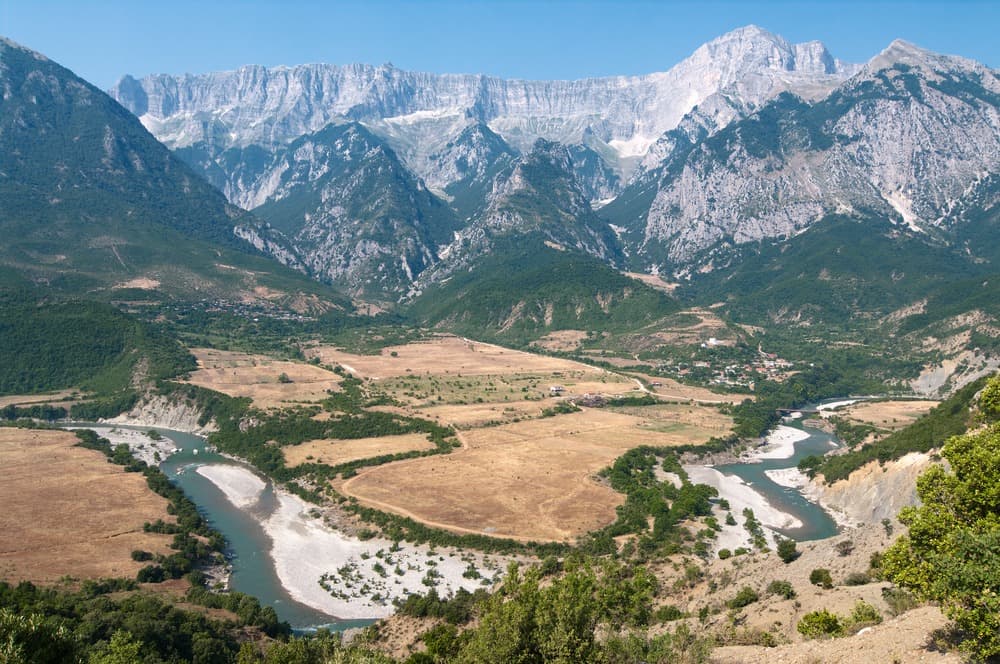
Bredhi i Hotoves National Park
Bredhi i Hotoves National Park
Northeast of Permet, Bredhi i Hotovës National Park protects 34,361 hectares of Mediterranean firs, diverse wildlife and five marked hiking trails.
The Bredhi i Hotovës-Dangëllisë National Park safeguards one of the most expansive forest massifs in southern Albanie. Located approximately 35 km northeast of Permet, in the Frashëri region, it harbours relic Mediterranean firs, large mammal fauna and several marked trails departing from a forest station. Admission is free and the park remains accessible year-round.
Why visit the park
The park stands out for the presence of the Hotova fir (Abies cephalonica), a Mediterranean species whose specimens reach 25 to 30 m in height. These stands rank among the country's most significant Mediterranean vegetation relics. The protected area, covering approximately 34,361 hectares following the perimeter expansion, makes it one of Albanie's largest natural spaces.
Beyond the forest, the site combines high-altitude meadows, valleys, traditional villages and cultural heritage linked to the Albanian Renaissance. Visitor numbers remain moderate compared to the southern coast, making it an ideal stop for travellers seeking nature and hiking rather than developed tourist infrastructure.
History and protection status
The area was granted national park status on 15 January 1996 by decision of the Albanian government. Its management is shared between the National Protected Areas Agency and the forest service of Permet district. This protection has helped limit deforestation on ancient stands.
The park is today subject to particular attention due to hydroelectric dam projects, notably at the Langarica canyon. Environmentalist demonstrations have been organised in Tirana to protest these developments deemed incompatible with ecosystem preservation and local tourism economy.
What to see and do
Forest and flora
Hotova fir stands dominate the landscape and lend their name to the park. Associated flora includes red and black juniper, hornbeam, maple and raspberry. Between 800 and 1,000 m altitude, meadows and plains bordered by centuries-old trees stretch out, providing ideal terrain for observation and hiking.
Wildlife
The mosaic of habitats supports varied fauna. The red deer is the flagship species, observable in pastures. Forests also shelter:
- wild boar, roe deer, red squirrel, badger;
- Eurasian otter, wildcat;
- red fox, grey wolf and brown bear in the most remote areas.
Birdlife includes remarkable species: eagle owl, barn owl, sparrowhawk, kestrel, golden eagle, Egyptian vulture and lanner falcon.
Hiking
Five marked trekking routes depart from the forest station. Orientation signs mark the trails and a GPS map can be obtained from park officials, who also provide information on terrain conditions. The Lumica valley, near Mount Kokojka, serves as a natural gateway to the most forested areas.
Cultural heritage
In Frashëri, the Frashëri Brothers Tower House and Museum, restored by the Albanian government in the 1970s, displays sculptures, ancient documents and photographs tracing the Frashëri brothers' role in the Albanian Renaissance.
When to visit
The park can be visited year-round, though conditions vary considerably by season:
- Spring (April-June): flowering, passable trails, mild temperatures.
- Summer (July-August): peak season for wildlife observation and high-altitude hiking; cooler air than lowlands.
- Autumn (September-October): striking colours, low visitor numbers.
- Winter: possible snowfall at altitude, some access points limited.
Practical information
- Admission: free.
- Opening: year-round, no fixed hours.
- Accommodation: no formal structures within the park. Camping is tolerated near the forest station with prior authorisation from competent authorities. Nearest lodging is in Permet.
- Equipment: hiking boots, water, altitude-appropriate clothing. No food service on site.
How to get there
Access is via the SH75 road from Piskova, heading northeast. As the road is in poor condition over several sections, a 4x4 vehicle is recommended, particularly after rain or in winter. From Permet, allow approximately one hour to reach the forest station.
Nearby attractions
- Langarica Canyon: gorges suitable for rafting and swimming downstream.
- Katiu Ottoman Bridge: photogenic stone structure spanning the Langarica.
- Benja thermal springs: natural warm water pools at the foot of Katiu Bridge.
- Traditional villages: Hotova, Kreshova, Ogreni, Sorropulli, Pagria, exemplifying the region's rural architecture.
Frequently asked questions
Frequently asked questions
No, access to Bredhi i Hotovës-Dangëllisë National Park is free and possible year-round.
Access is via the SH75 from Piskova. As the road is in poor condition, a 4x4 vehicle is highly recommended, especially in wet weather.
There is no formal accommodation on site. Camping is tolerated near the forest station with prior authorisation from authorities. The nearest hotels are in Permet.
Five marked trekking routes depart from the forest station, with orientation signs and GPS maps available from park officials.
Red deer is the emblematic species. The park also hosts wild boar, roe deer, otter, wildcat, as well as grey wolf and brown bear in remote areas. Birdlife includes golden eagle and Egyptian vulture.
Planning your trip
Bredhi i Hotovës Park integrates naturally into an itinerary combining the Permet region, Benja thermal springs and Langarica Canyon. To design a tailor-made circuit including this nature stop, consult our Albanie journeys.
Interested in this visit?
We can include it in your personalised itinerary.