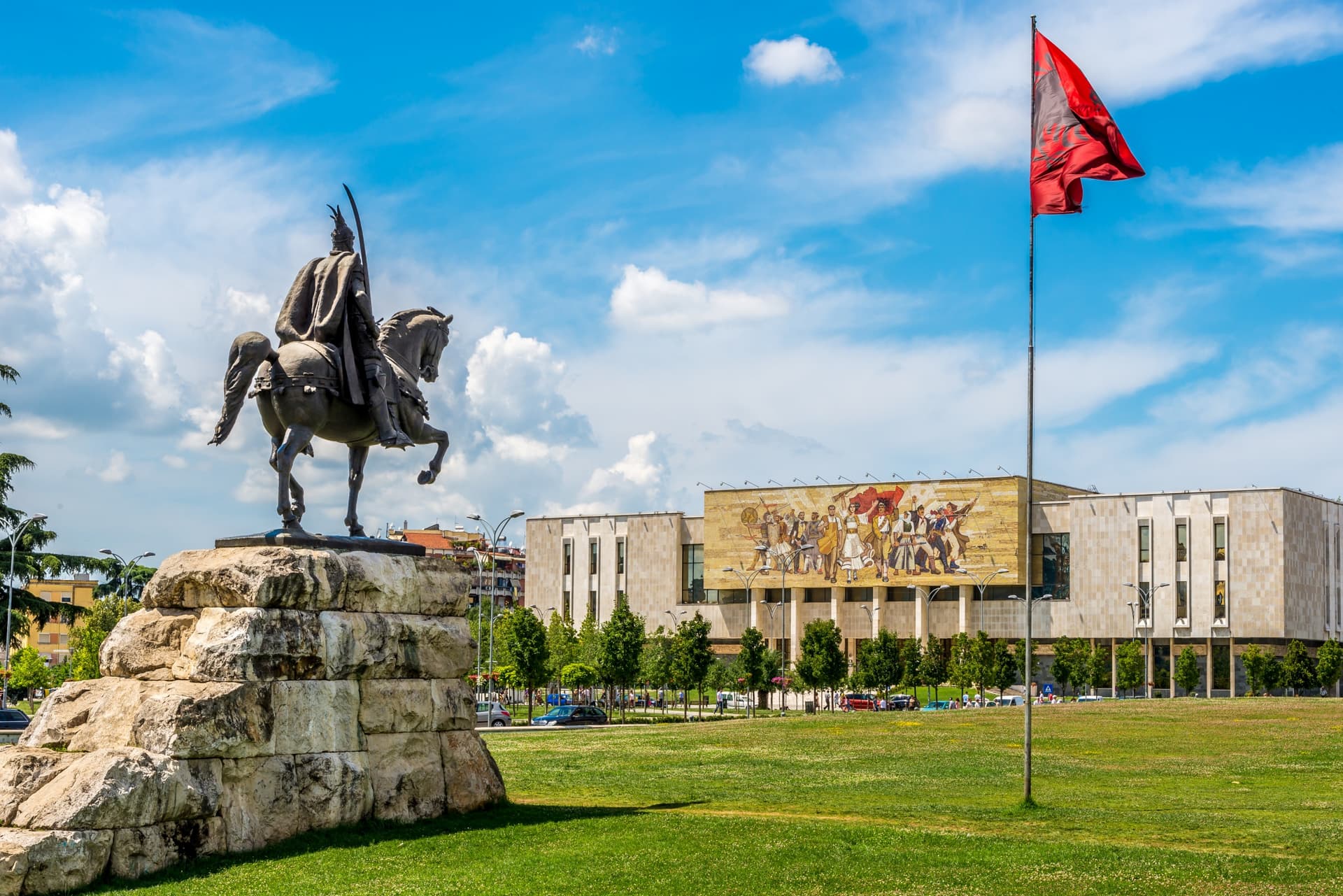
National History Museum of Tirana
National History Museum of Tirana
On Skanderbeg Square, Albania's largest museum traces 8,000 years of history through 8 pavilions and 6,200 objects, from the Paleolithic to the communist regime.
The National History Museum of Tirana occupies Albania's largest cultural building, on Skanderbeg Square in the heart of the capital. Its collection of 6,200 objects traces the country's history from the Paleolithic period to the fall of the communist regime, across eight thematic pavilions. The exhibitions are presented largely in English.
Why visit the National History Museum
- Understand 8,000 years of Albanian history in one place, from the Illyrians to the post-communist period
- See the replica of Skanderbeg's sword and the Gllavenica epitaph from 1373
- Access a unique pavilion dedicated to communist terror, opened in 2012
- Admire a collection of post-Byzantine icons signed by Onufri, David Selenica, and Kostandin Shpataraku
- Central location on Skanderbeg Square, within walking distance of most central Tirana hotels
History of the museum
The museum officially opened on October 28, 1981, at a time when Albania lived under the regime of Enver Hoxha. The building, with a total area of 27,000 m², embodies characteristic Soviet aesthetics. Its façade is adorned with a vast mosaic titled "the momentum of the Albanian people toward their independence and identity," an emblematic image of Skanderbeg Square.
The building was designed by architects Enver Faja, Petraq Kolevica, Sokrat Mosko, and Nina Shehu. Of the 27,000 m² building, 18,000 m² are dedicated to exhibition halls, with the remainder housing archives, laboratories, and conference spaces.
What to see in the museum
The scenography follows a chronological order. The ground floor covers prehistoric, Illyrian, Greek, and Roman periods. The first floor is dedicated to the Middle Ages and the Albanian Renaissance. The collections are organized into eight pavilions.
Antiquity Pavilion
The richest section of the museum, with more than 500 objects dating from the Upper Paleolithic to the 8th century. Notable finds include remnants from the prehistoric settlement of Maliq, documenting early human occupation of the Korçë basin.
Middle Ages Pavilion
Covers the period from the 6th to 16th century and illustrates the social, economic, and political life of Albanian populations. A space is dedicated to the Principality of Arber, the first medieval political entity of the territory. To see: the Gllavenica epitaph created in 1373, as well as engravings and objects related to Skanderbeg's resistance against the Ottoman Empire, including a replica of his sword.
Renaissance Pavilion
Documents, books, banknotes, photographs, flags, and weapons from the 19th century until 1912. The flag of the patriotic society "Desire," from the Albanian colony of Sofia, holds a special place. The desk and personal library of Sami Frasheri (1825–1904), a figure of Albanian cultural nationalism, are also displayed.
Independence Pavilion
Dedicated to major political events: the proclamation of independence on November 28, 1912, the Conference of Ambassadors in London that same year, the brief reign of Prince Wied in 1914, and the conflicts between Fan Noli and the ruling elite in 1924.
Albanian Iconography Pavilion
Post-Byzantine Albanian art through icons, holy doors, a proskynétarion, and the iconostasis from the Monastery of Saint John Vladimir in Elbasan. The works, dated from the 16th to 19th century, are signed by Onufri, David Selenica, the Zografi brothers, and Kostandin Shpataraku, and come from churches in Fieri, Gjirokastër, and Berat.
Antifascist War Pavilion
220 objects trace the period from the Vlora War in 1920 to the end of World War II in 1945, with a section on the actions of Albanian intellectuals against fascism in the interwar years.
Communist Terror Pavilion
Opened in 2012, this pavilion documents the single-party period between 1945 and 1990. Photographs, archives, and relics of regime opponents are complemented by a film provided by the Central Film Archives, which reconstructs the repression of dissent.
Mother Teresa Pavilion
The family, religious, and charitable life of the saint of Albanian origin. You will see her personal belongings and several photographs showing her alongside Bill Clinton, Jacques Chirac, or artist Ibrahim Kodra.
Practical information
- Duration of visit: allow 2 to 3 hours to explore all pavilions at a leisurely pace
- Languages: most labels are in Albanian and English; French commentary is rare
- Fees: entry at a modest rate, with discounts for groups, students, children aged 12 to 18, retirees, and persons with disabilities. Free admission for children under 12
- Hours: open daily except Monday, during daytime. Check updated hours before your visit, as they vary by season
- Photography: generally allowed without flash, subject to signage in galleries
How to get there
The museum is located on Skanderbeg Square, the geographic and symbolic heart of Tirana. From most central hotels, it is reachable on foot within a few minutes. Public buses also serve the immediate surroundings of the square, and a taxi remains an economical option in the city.
Tirana's international airport, about ten kilometers to the northwest, has connections to several major European cities. Trains connect Tirana to Shkodra and Durrës, while bus services run from Athens and Prishtina.
Around the museum
- Tirana: Skanderbeg Square, Et'hem Bey Mosque, the Clock Tower, and the Blloku district can be explored on foot around the museum
- Castle of Krujë: approximately 40 km north, Skanderbeg's former stronghold and a natural complement to the museum visit
- Lake Shkodra: the largest lake in the Balkans, halfway between Tirana and the Montenegrin border
- Butrint: a UNESCO-listed Greco-Roman archaeological site in the south of the country
Frequently asked questions
Frequently asked questions
Allow 2 to 3 hours to explore the eight pavilions at a normal pace. A quick visit focused on Antiquity, the Middle Ages, and the communist terror pavilion can be done in 1.5 hours.
Yes. The labels are primarily in Albanian and English. A good understanding of English is helpful to fully enjoy the content.
Access to the building is possible, but interior amenities remain partial. Ask at the reception desk about elevators and circulation between floors.
Yes. The museum is located on Skanderbeg Square, from which you can reach Et'hem Bey Mosque, the Clock Tower, and the Blloku district on foot. One day is enough to combine a museum visit with urban exploration.
It depends on your interests. The Antiquity pavilion is the richest in objects, the Albanian Iconography pavilion is unique for post-Byzantine art, and the communist terror pavilion sheds light on a period still poorly documented elsewhere.
Planning your trip to Albania
The National History Museum is an ideal gateway to understanding Albania before or after traveling through the country. To build an itinerary combining Tirana, the Ionian coast, archaeological sites, and the northern highlands, consult our tailor-made Albania trips.
Interested in this visit?
We can include it in your personalised itinerary.