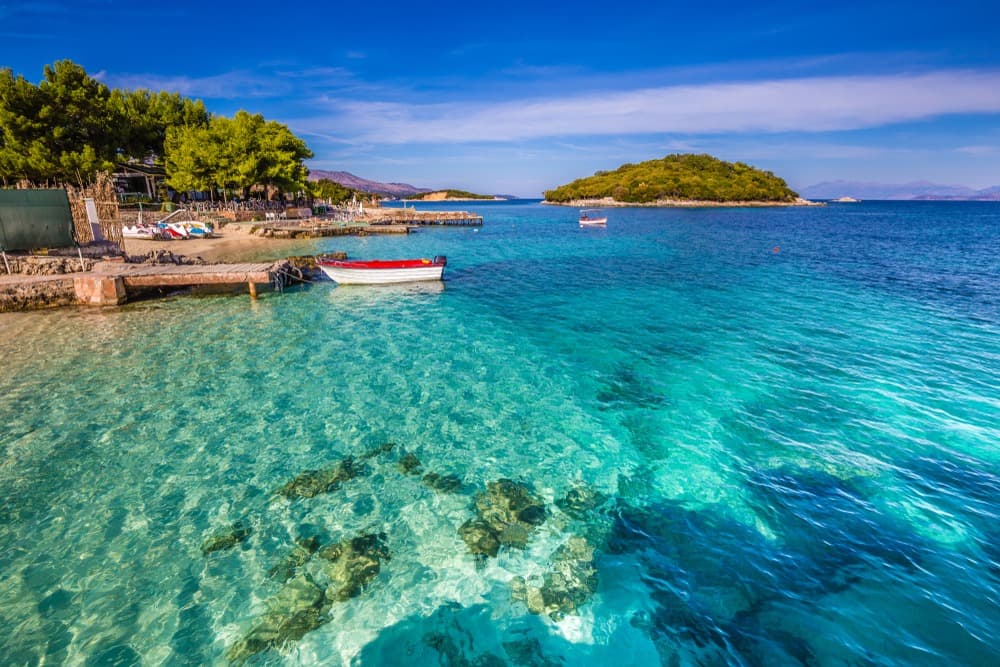
Albanian Riviera
Albanian Riviera
130 km of coastline between the Adriatic and Ionian seas: perched villages, pebble beaches, Butrint Park and Llogara Pass. Historical landmarks and practical advice.
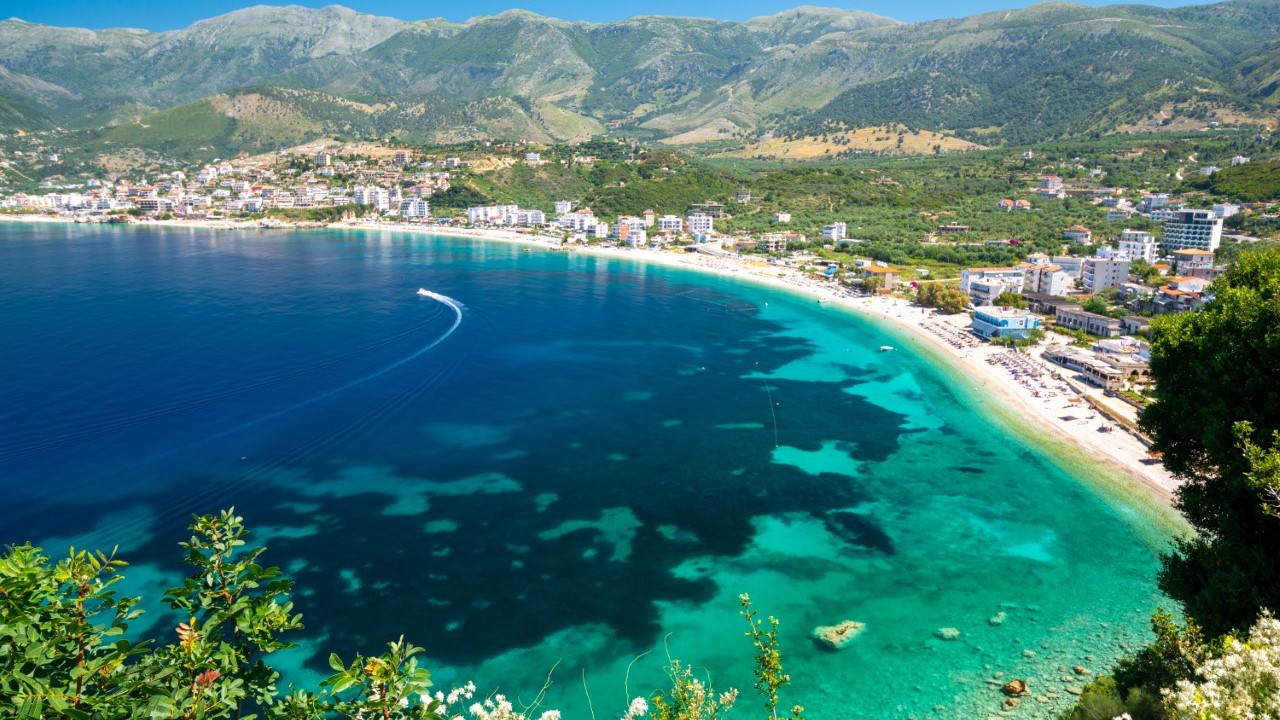
The Albanian Riviera refers to the coastal strip stretching some 130 km between the Adriatic Sea to the north and the Ionian Sea to the south, connecting the cities of Vlorë and Sarandë. Known locally as Riviera shqiptare or Bregu, it alternates between perched villages, pebble beaches, coves accessible only by boat, and the steep relief of the Çika massif. Still relatively undeveloped compared to neighbouring rivieras, it draws visitors for its spectacular geography and Mediterranean heritage blending Greek, Roman, Venetian and Ottoman legacies.
Why visit the Albanian Riviera
The region offers a rare combination in the Mediterranean: a pristine coastline, waters with temperatures ranging from 13 to 25°C depending on the season, and a mountainous hinterland where villages like Dhërmi or Himarë preserve their stone architecture. The Frommers guide named it a "top value destination" in 2012, a distinction that marked the beginning of measured but growing tourism.
Unlike the Croatian or Greek coasts, urbanisation remains limited, and it's possible to walk certain coastal paths without encountering a single resort complex. The contrast between the Llogara Pass at over 1,000 m altitude and the beaches just 30 minutes below is one of the region's defining features.
Historical landmarks
In 48 BC, Julius Caesar landed in the region while pursuing Pompey. His legion established itself at Palasë before crossing the Llogara Pass, now called Caesar's Pass. This episode ties the Riviera to Roman military history and explains the persistence of ancient place names along the coast.
In the Middle Ages, the coast was successively Byzantine then Venetian, before coming under Ottoman control. Porto Palermo Castle, linked to the figure of Ali Pasha of Janina (early 19th-century Ottoman governor), testifies to this final period. The Zvërnec Monastery, on an islet near Vlorë, preserves 13th-century Byzantine architecture.
What to see on the Riviera
Towns and villages
- Sarandë: main town in the southern Riviera, departure point for Butrint and Ksamil.
- Vlorë: northern gateway, the city where Albanian independence was proclaimed in 1912.
- Dhërmi: perched village at around 200 m altitude, overlooking the Ionian Sea.
- Himarë: coastal village dominated by the ruins of a castle.
- Borsh: known for its olive groves and a beach around 7 km long.
Historic and cultural sites
- The Butrint National Park, a UNESCO World Heritage site, bringing together Greek, Roman, Byzantine and Venetian remains.
- Porto Palermo Castle, a fortified peninsula associated with Ali Pasha.
- Zvërnec Monastery and its 13th-century Byzantine architecture.
- The ruins of Himarë Castle, in the old upper town.
- The Lëkurësi Castle, which overlooks Sarandë.
Natural sites
- The Llogara National Park and its pass, offering sweeping coastal views.
- Gjipe Canyon, accessible by a trail from the road, opening onto an enclosed beach.
- The Karaburun Peninsula, wild and accessible primarily by boat.
Remarkable beaches
- Ksamil: shallow waters and islets accessible by swimming, very busy in high season.
- Borsh: around 7 km of fine pebbles, among the country's longest beaches.
- Gjipe Beach: cove at the mouth of the canyon, frequented by hikers.
- Drymades and Palasa: beaches backed by the village of Dhërmi.
- Grama Bay: isolated cove between the rocky massifs of Karaburun, accessible by boat.
When to go
The climate is Mediterranean: hot, dry summers and mild, wetter winters. High season runs from mid-June to early September, with water temperatures around 23-25°C in July-August. May, June and September offer a good compromise: stable weather, still-pleasant sea temperatures and fewer crowds. Off-season (October to April), many coastal establishments are closed and water temperatures drop to around 13-15°C, but the coast is well-suited for hiking and visiting archaeological sites.
Practical information
The coastal road SH8 connects Vlorë to Sarandë via the Llogara Pass. Speed is limited to 80 km/h and the winding route requires time: plan on approximately 4 to 5 hours to cover the entire stretch non-stop. Cash payments in Albanian lek remain widely used in villages, though credit cards are accepted in hotels and restaurants of major resorts. A few ATMs are available in Sarandë, Himarë and Vlorë.
Price levels remain moderate compared to neighbouring destinations, but have risen noticeably in high season in recent years. Book accommodation in advance for July-August.
How to get there
Tirana International Airport is the main entry point. From Tirana, allow around 3 hours of driving to the Llogara Pass, and 5 to 6 hours to Sarandë. An alternative is to fly to Corfu, Greece, then reach Sarandë by ferry (crossing around 30 minutes to 1 hour 15 minutes depending on the boat). A car, whether rented or through an agency, remains the most practical way to explore the Riviera; buses and minibuses (furgon) connect major towns, and taxis are available in Sarandë and Vlorë.
Nearby
- The Karaburun Peninsula, a wild extension north of Vlorë.
- The Llogara National Park, the junction between the Vlorë plain and the Ionian coast.
- The archaeological site of Butrint, around thirty kilometers south of Sarandë.
Frequently asked questions
Frequently asked questions
Preparing your trip
The Albanian Riviera lends itself to a full circuit or a beach stopover within a larger journey. To build a tailor-made itinerary blending Ionian coast, ancient sites and mountains, consult our trip suggestions for Albanie.
Interested in this visit?
We can include it in your personalised itinerary.