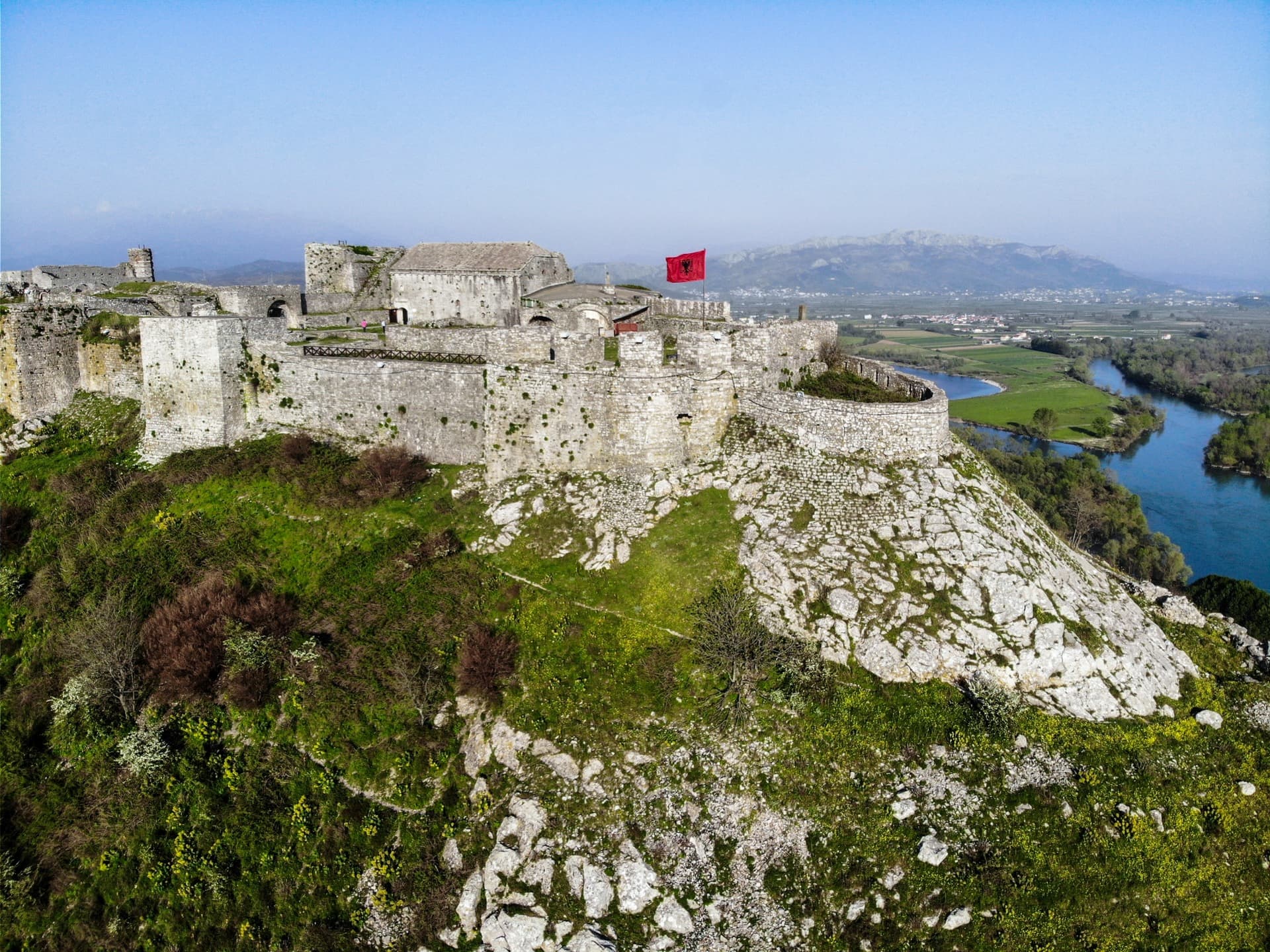
ROZAFA CASTLE
ROZAFA CASTLE
Dominating Shkodra at the confluence of the Drin and Buna rivers, Rozafa Castle brings together more than two millennia of history, seven towers and a founding legend.
Rozafa Castle dominates the city of Shkodra, at the confluence of the Drin and Buna rivers in northern Albanie. An Illyrian fortress that became a Venetian stronghold and then Ottoman bastion, the site combines military remains, panoramic views over the lake and a founding legend that marks Albanian culture: that of Rozafa, a young woman entombed alive to allow the ramparts to be completed.
Why visit Rozafa Castle
The castle brings together several points of interest in a single location. Historically, it bears witness to more than two millennia of occupation, from the Illyrians to the Ottomans, passing through Rome, Venice and the Kingdom of Montenegro. Scenically, its position on a rocky hilltop 4 km south of Shkodra's centre opens up a broad view over the city, Lake Shkodra, the rivers and the first ridges of the Albanian Alps. Culturally, the legend of Rozafa remains a founding narrative passed down through generations, which sheds light on the Albanian relationship with sacrifice and motherhood.
Over two millennia of history
Built by the Illyrians in antiquity, the castle fell under Roman rule in 167 BC. The medieval city of Shkodra then established itself directly south of the hill, at the confluence of the Drin and Buna. Research conducted by German explorer Johann Georg von Hahn in the 19th century helped document this ancient settlement.
The fortifications visible today are largely of Venetian origin, before being completed and adapted by the Ottomans following their invasion in 1478. The fortress was still involved in much later confrontations, notably during the siege led by Montenegro in 1912.
The legend of Rozafa
The castle's foundation rests on an oral narrative. Three brothers were working on building the walls, but what they constructed during the day collapsed at night. On a wise man's advice, they decided that a human sacrifice was necessary and chose to entomb the first of their wives to bring them the next day's meal. It was Rozafa, the wife of the youngest. Mother of an infant, she accepted her fate on the condition that they leave exposed her right breast to nurse her child, her right hand to caress him, her right foot to rock him and her right eye to look at him. At the castle's main entrance, the limestone-rich water that seeps from the stones is traditionally associated with Rozafa's milk.
What to see on the site
The estate covers approximately 6 hectares and includes seven towers, organised around three main courtyards where ruins dating back to the 4th century remain. Several elements deserve attention:
- The Balshaj Towers, of Venetian origin, among the most representative of the fortifications.
- Shkodra Mosque, a former Catholic church of the 13th-15th centuries, converted into a mosque under Ottoman rule between the 16th and 19th centuries.
- Saint Stefan Cathedral, the city's principal Catholic place of worship, and the statue of Mother Teresa, hands crossed over her chest.
- The castle museum, housed in a former Venetian mansion, which presents Ottoman weapons, ancient coins and everyday Illyrian objects.
- Tortoises that live in the wooded areas of the park, easy to spot in quiet corners.
Plan for 1.5 to 2.5 hours to tour the perimeter unhurriedly and take in the panorama over Shkodra, the lake and the plain.
Practical information
The castle can be visited year-round. In high season (spring and summer), hours are extended in the evening; in winter, closing occurs in mid-afternoon. The entrance fee is moderate, payable in lekë on site. Plan to wear good shoes: the ground is uneven and the site is partially paved.
When to go
The months of April to June and September to October offer the best conditions: mild temperatures, favourable light for panoramic views, moderate crowds. Summer remains possible but the hill is very exposed to the sun at midday. At the end of March, the Lojra Popullore festival celebrates traditional games from the north of the country and provides an opportunity to visit the castle in a particular cultural context.
How to get there
The castle is located approximately 4 km south of Shkodra's city centre. From the city, municipal buses stop near the site entrance, and taxis stand at the foot of the hill. On the way out, rental bicycles allow you to ride back down towards the river and fishing villages.
From Tirana, 116 km away, allow approximately 2 hours by bus to reach Shkodra. The city is also connected by furgons (minibuses) to Koman, Thethi, Velipojë and Kelmend. International bus services are available from Ulcinj and Podgorica in Montenegro, as well as from Gjakova in Kosovo via the Prizren motorway.
What to see nearby
Shkodra and its region offer several natural extensions to a visit to the castle:
- The old quarters of Serreqi and Gjuhadoli, among the most characteristic of the city.
- The Mes Bridge, built in the 18th century in the village of Mesi approximately 6 km away: 13 stone arches spanning 108 metres, above the Kiri river.
- The ruins of Shurdhahu, about fifteen kilometres from Shkodra.
- Sarda, an ancient medieval city and residence of the Dukagjini, now an island in Lake Vau i Dejës.
- Lake Shkodra and, further north, the mountain village of Lepushë.
- To extend the theme of Albanian fortresses, Krujë Castle, linked to Skanderbeg.
FAQ
Frequently asked questions
Plan for 1.5 to 2.5 hours to tour the three courtyards, climb the ramparts, visit the museum and enjoy the panorama without rushing.
Yes, the site is open year-round with extended hours from spring to autumn and mid-afternoon closing in winter.
According to tradition, a young woman named Rozafa was entombed alive in the foundations to allow the fortress to be completed, on the condition that her right breast, right hand, right foot and right eye remain exposed to nurse, caress, rock and look at her infant.
The site is 4 km south of the centre. You can take a municipal bus, a taxi or rent a bike. Taxis also stand at the foot of the hill for the return journey.
April to June and September to October offer the most pleasant conditions. At the end of March, the Lojra Popullore festival adds a cultural dimension to the visit.
Plan your trip
Rozafa Castle fits naturally into an itinerary combining Shkodra, the lake and the Albanian Alps. To prepare a full stay, consult our trips to Albanie.
Interested in this visit?
We can include it in your personalised itinerary.