Sultan Ahmed Mosque (Blue Mosque)
Sultan Ahmed Mosque (Blue Mosque)
The Sultan Ahmed Mosque, known as the Blue Mosque, commands the historic heart of Istanbul with its six minarets and twenty thousand turquoise-blue Iznik tiles. Free admission, active place of worship.
The Sultan Ahmed Mosque, built in the early seventeenth century in the historic heart of Istanbul, is one of the rare Ottoman mosques to feature six minarets. Its nickname comes from some twenty thousand turquoise-blue Iznik faience tiles that line the interior. It faces Hagia Sophia on the former Hippodrome square and remains an active place of worship, open to visitors outside prayer hours.
Practical information at a glance
- Admission: free for non-Muslim visitors (outside prayer hours)
- Closed to tourists: during the five daily prayers (approximately 90 minutes each) — check prayer times posted at the entrance on the day itself
- Suggested duration: 30 to 45 minutes
- Dress code: shoulders and knees covered, head covered for women; scarves are provided at the entrance
- Footwear: to be removed before entering (bags provided)
- Access: tram T1, Sultanahmet stop
- Accessibility: step-free access possible via the side entrance
What to see
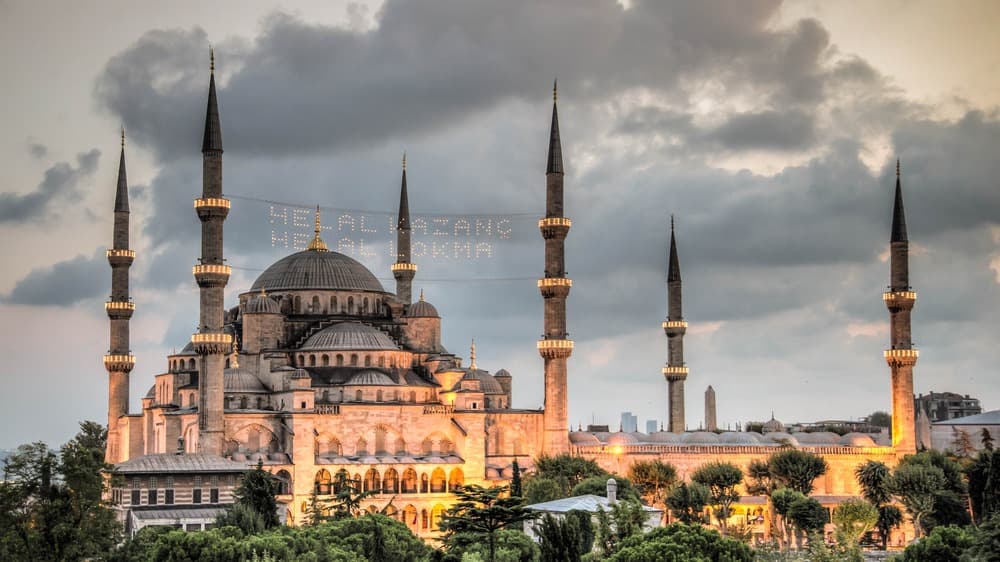
The interior strikes you with its luminosity: two hundred and sixty windows diffuse soft light onto the Iznik tiles with their floral motifs in blue, green and white. The central dome reaches approximately 43 metres. Red carpets, brass chandeliers and Quranic calligraphy compose a cohesive ensemble. Outside, the silhouette of six minarets and cascading domes is recognisable from the Sea of Marmara.
History and context
Sultan Ahmed I commissioned the mosque in 1609; it was completed in 1616, a year before his death. Architect Sedefkâr Mehmed Ağa, a student of Sinan, drew inspiration from nearby Hagia Sophia for the arrangement of semi-domes. The choice of six minarets — as many as the mosque of Mecca at the time — sparked controversy; Ahmed I is said to have financed a seventh minaret in Mecca to settle the dispute.
Highlights of the visit
The Iznik tiles
Produced in the Iznik workshops at the height of their craft, these faiences feature tulips, carnations and cypresses of remarkable precision. The characteristic cobalt blue and tomato red of this period are particularly visible in the upper galleries.
The outer courtyard
Surrounded by a portico with granite and porphyry columns, the courtyard houses a central ablution fountain. This is where the silhouette of the six minarets is best perceived, especially in the early morning when the crowds are sparse.
The mihrab and minbar
The mihrab (niche indicating the direction of Mecca) is framed with among the finest Iznik tiles in the building. The minbar in sculpted white marble, from which the imam delivers the Friday sermon, is a refined example of Ottoman craftsmanship.
Etiquette and rules of visit
- Enter via the gate reserved for visitors (Hippodrome side), not the main entrance for the faithful.
- Speak in hushed tones; the mosque is in active use.
- Do not cross the prayer area delimited by a rope.
- Switch off or silence your phone.
- Avoid visits during Ramadan at peak prayer times.
Photography tips
Morning light (before 9 a.m.) is ideal outdoors: the sun illuminates the main facade without backlighting. Inside, the high windows create diffuse light favourable to the blue tiles; a wide-angle lens better captures the dome's height. Tripods are prohibited. From the Hippodrome park, sufficient distance allows you to frame all six minarets in full.
Location and access
The mosque is located in the Sultanahmet district, on the historic peninsula of Istanbul. The T1 tram (Sultanahmet stop) serves the site directly. Hagia Sophia is a two-minute walk to the northeast. The Topkapi Palace is accessible in ten minutes on foot. The main entrance for visitors overlooks the Hippodrome park.
In the vicinity
- Hagia Sophia — former Byzantine basilica converted into a mosque, two minutes' walk away.
- Topkapi Palace — residence of Ottoman sultans for four centuries, with views of the Bosphorus.
- Hippodrome of Constantinople — ancient Roman racing track, with the Theodosian Obelisk and Serpent Column remaining.
- Basilica Cistern — Byzantine underground reservoir with illuminated columns, five minutes' walk away.
- Museum of Turkish and Islamic Arts — collections of carpets, calligraphies and Ottoman ceramics, facing the Hippodrome.
Frequently asked questions
Yes, admission is free for non-Muslim visitors. Only compliance with dress code and prayer time rules is required.
Weekday mornings, right after the first prayer opens, are noticeably less crowded. Avoid midday and July-August weekends.
Shoulders and knees covered for everyone. Women must cover their head; scarves are available free of charge at the entrance if you don't have one.
Yes, the two monuments are two minutes' walk from each other. Allow half a day to visit both sites without rushing.
Yes, photography is allowed without flash or tripod. Be discreet and do not photograph the faithful at prayer.
The T1 tram line (Kabataş–Bağcılar route) serves the Sultanahmet stop, less than two minutes' walk from the mosque. From Taksim, allow approximately 25 minutes by tram with a funicular connection.
Photos
Interested in this visit?
We can include it in your personalised itinerary.