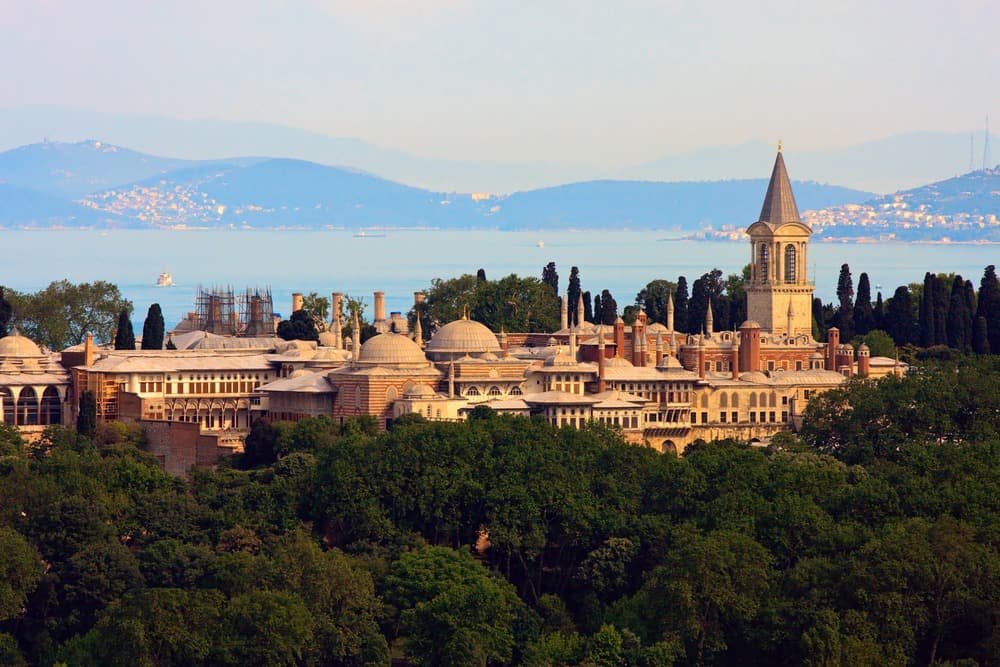
Topkapi Palace
Topkapi Palace
Once the administrative heart of the Ottoman Empire for four centuries, Topkapi Palace dominates the tip of the Saray in Istanbul. An imperial treasury, harem, and porcelain collections make it one of the richest museums in the Islamic world.
Perched on the tip of the Saray, between the Golden Horn and the Sea of Marmara, Topkapi Palace served as the administrative and residential heart of the Ottoman Empire for nearly four centuries. Built from 1459 on the orders of Mehmed II, it now houses one of the richest museums in the Islamic world: collections of Chinese porcelains, prophetic relics, imperial jewels, and harem apartments that bear witness to a power stretching across three continents.
Practical information at a glance
- Entrance: paid entry (museum ticket + harem supplement, sold separately); covered by Istanbul Museum Card
- Weekly closure: Tuesday (palace is closed)
- Recommended duration: 3 to 4 hours for the main courts; an additional half-day if you visit the harem
- Dress code: no strict dress requirements in outdoor courts; smart casual recommended in pavilions
- Accessibility: partial access — courts are navigable, but some historic pavilions have steps
- Early arrival: queues lengthen quickly during peak season; prefer arrival at opening
What to see
The palace is organized into four successive courts, each more private than the last. The first court, public-facing, leads to the Gate of Salutation. The second houses the imperial kitchens repurposed as galleries of porcelains and silverware. The third, the seat of power, concentrates the Throne Room, Ahmed III's library, and the imperial treasury. The fourth offers marble pavilions and terraces overlooking the Bosphorus.
History and context
Mehmed II laid the first stones in 1459, six years after the conquest of Constantinople. The palace expanded under each sultan: Süleyman the Magnificent added pavilions, Murad III installed the definitive harem. In 1853, Abdülmecid I transferred the court to the more modern Dolmabahçe Palace. Topkapi became a museum in 1924, by decree of the newly founded Turkish Republic.
Highlights of the visit
The Imperial Treasury
In the fourth court of the treasury: the emerald-encrusted Topkapi dagger and the Kaşıkçı diamond (86 carats) draw most eyes. The display cases also feature armor, thrones, and solid gold objects accumulated over four centuries of conquest.
The Chamber of Sacred Relics
In the Pavilion of Sacred Mantles, relics attributed to the Prophet Muhammad—his cloak, sword, footprint, and beard hairs—are preserved in Ottoman reliquaries. The atmosphere is contemplative; Quranic recitations resound continuously.
The Harem
Accessible by separate ticket, the harem contains over 400 rooms. The apartments of the Valide Sultan, marble bathhouses, and private courts illustrate the complexity of court life. The visit follows a marked guided or audio-guided route.
The Imperial Kitchens and the porcelain collection
The ten domes of the kitchens house one of the world's largest collections of Chinese porcelains outside China—Song celadons, Ming blue-and-white—along with Bohemian crystals and Iznik pottery.
The terraces and views of the Bosphorus
The Baghdad Pavilion and the Circumcision Pavilion, in the fourth court, overlook the confluence of the Bosphorus, the Golden Horn, and the Sea of Marmara. It is one of Istanbul's most breathtaking urban panoramas.
Photography tips
Morning light works best in the interior courts before visitor crowds arrive. Iznik tiles in the harem apartments photograph best with a wide-angle lens and no flash. The terraces of the fourth court offer natural framing of the Bosphorus in late afternoon. Photography is permitted in nearly all spaces, except where otherwise indicated in certain treasury rooms.
Location and access
The palace sits at the tip of the Saray in the Sultanahmet district, just a few minutes' walk from Hagia Sophia and the Blue Mosque. Tram line T1 stations Gülhane or Sultanahmet serve the site directly. The main entrance is located beyond Gülhane Park, through the Imperial Gate (Bab-ı Hümayun). Accessible access is possible via the main entrance; ramps facilitate circulation through the courts.
Nearby attractions
- Hagia Sophia — Five minutes on foot, the former Byzantine basilica converted into a mosque, symbol of Ottoman conquest.
- Blue Mosque (Sultan Ahmed) — Opposite Hagia Sophia, famous for its six minarets and twenty thousand Iznik tiles.
- Basilica Cistern — A sixth-century Byzantine underground reservoir, two minutes on foot from Hagia Sophia.
- Istanbul Archaeological Museum — Just below Topkapi, it houses the Sarcophagus of Alexander and major ancient collections.
- Gülhane Park — Former imperial garden of Topkapi, pleasant for a break before or after your visit.
Frequently asked questions
The palace is closed on Tuesday. It is open to visitors all other days of the week.
Yes. The harem requires a separate ticket in addition to the general admission ticket. Both are covered by the Istanbul Museum Card if you visit multiple museums.
Allow 3 to 4 hours for the four courts and main collections. Add 1 to 2 hours if you explore the harem in detail.
Yes, both sites are five minutes apart on foot. Start at Topkapi at opening to avoid queues, then head to Hagia Sophia in early afternoon.
It is permitted in the vast majority of spaces. Some treasury rooms display a prohibition; respect the signs on-site.
Spring (April–May) and autumn (September–October) offer pleasant temperatures and lower crowds than July–August. In peak season, arrive at opening to minimize queuing at the ticket office.
Photos
Interested in this visit?
We can include it in your personalised itinerary.