Basilica Cistern (Yerebatan Sarnıcı)
Basilica Cistern (Yerebatan Sarnıcı)
Beneath Sultanahmet, the Basilica Cistern unfolds 336 marble columns in aquatic silence. A 6th-century Byzantine archaeological site, steps away from Hagia Sophia.
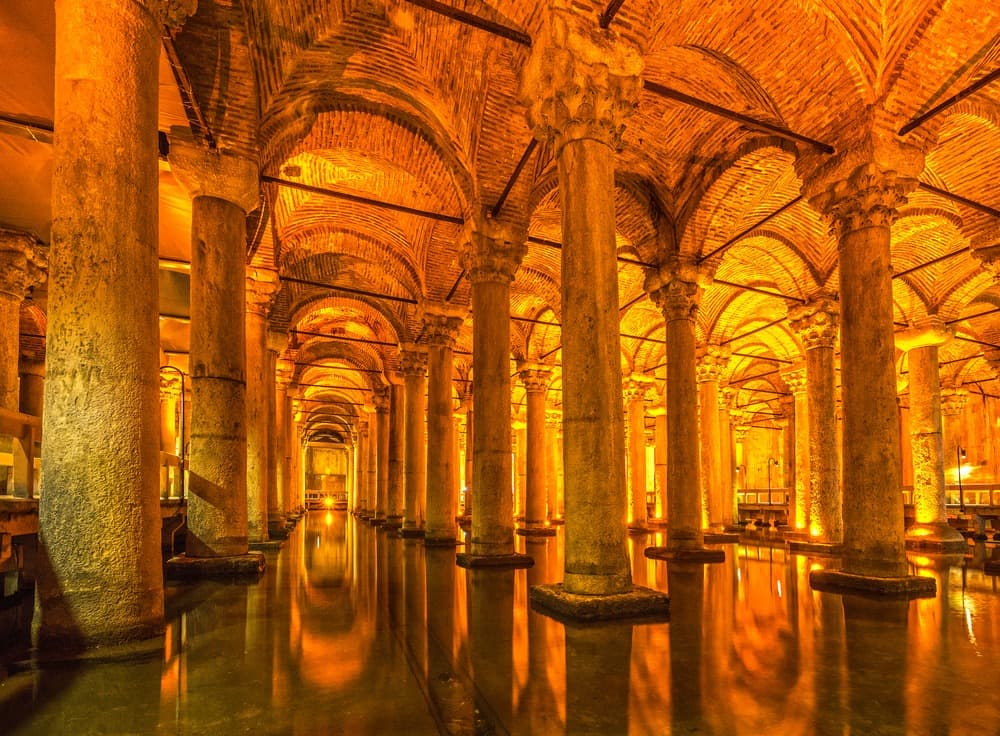
Beneath the streets of Sultanahmet, mere minutes from Hagia Sophia, lies Istanbul's largest Byzantine cistern. Built in the 6th century, it could store up to 80,000 cubic meters of water. Its 336 marble columns, reflections dancing across dark waters, and two Medusa-head capitals make it one of the city's most singular archaeological sites.
Practical Information at a Glance
- Admission: Paid entry (rates vary by season; check the official website or your local guide)
- Access: Tram T1, Sultanahmet stop — entrance on Yerebatan Caddesi
- Recommended duration: 45 minutes to 1 hour
- Dress code: No restrictions (archaeological site, not a place of worship)
- Accessibility: Limited — the interior features stairs and narrow walkways
- Tip: Book your ticket online to skip queues, especially during peak season
What You'll See
The cistern unfolds as a forest of columns arranged in 28 rows of 12 columns each. Subdued lighting reveals reflections in the water that still partially covers the floor. Two columns in the northwest corner rest on blocks carved as Medusa heads — one inverted, the other on its side. Their exact origin remains debated among scholars.
History and Context
The cistern was built during the reign of Emperor Justinian I, around 532 CE, to supply the Grand Palace of Constantinople with fresh water. The columns were salvaged from various ancient buildings and repurposed without concern for uniformity. After the Ottoman conquest of 1453, the cistern gradually fell into obscurity before being rediscovered and restored in the late 20th century.
Highlights of Your Visit
The Medusa Heads
These two carved blocks, used as column bases, fascinate as much for their scale as for their deliberately tilted positioning. Several theories circulate about their origin and orientation, yet no definitive consensus has emerged.
The Forest of Columns
The alignment of 336 columns—some Corinthian, others Ionic or Doric—creates a hypnotic perspective. Artificial lighting accentuates reflections in the water, suffusing the entire space with a particularly dense atmosphere.
The Weeping Column
An isolated column, covered in relief patterns evoking eyes or tears, is nicknamed the "weeping column." Its meaning remains uncertain, fueling visitors' interpretations.
Photography Tips
Lighting is entirely artificial: a fast lens (f/1.8 or f/2.8) or high ISO sensitivity yields better results. Water reflections offer symmetrical compositions from the walkways. Avoid flash, which flattens textures and disturbs other visitors. The Medusa heads are heavily photographed — arrive early to frame them without crowds.
Location and Access
The cistern is located in the Sultanahmet district, Istanbul's historic heart. The T1 tram (Sultanahmet stop) serves the site directly. Hagia Sophia is less than five minutes on foot, as is the Blue Mosque. Accessibility for those with mobility challenges is difficult due to stairs at the entrance and narrow interior walkways.
Nearby Attractions
- Hagia Sophia — the former Byzantine basilica converted into a mosque, minutes away on foot.
- Blue Mosque (Sultan Ahmet Camii) — renowned for its six minarets and thousands of İznik tiles.
- Topkapi Palace — the former residence of Ottoman sultans, overlooking the Bosphorus.
- Hippodrome of Constantinople — the central square of ancient Constantinople, featuring the Obelisk of Theodsius.
- Grand Bazaar — one of the world's largest covered markets, about ten minutes on foot.
Frequently asked questions
During peak season (April-October), queues can be lengthy. Online booking is recommended to save time at the entrance.
Plan for 45 minutes to 1 hour to walk the entire network of walkways and observe the remarkable features at a leisurely pace.
Yes, both sites are less than five minutes apart. Half a day suffices to visit the cistern and Hagia Sophia, even the Blue Mosque.
Access is challenging: the entrance has stairs and interior walkways are narrow. Inquire with the site before your visit.
Yes, photography is allowed. Flash use is discouraged out of respect for other visitors and for photo quality in this dark environment.
The cistern is open year-round. During low season (November-March), crowds are thinner and waiting times are reduced. Interior temperature remains cool regardless of the season.
Photos
Interested in this visit?
We can include it in your personalised itinerary.